Signal behaviour
Tracking Error
How a changing disturbance environment can make it harder for a system to follow the musical signal precisely.
Explore Tracking ErrorTHE PHYSICS OF QUIET / 01
Why a familiar system can feel different from one listening session to the next.
Some days, a carefully assembled system draws you straight into the performance. The music has the ease and presence you remember from the moment you chose it. On others, although nothing obvious has changed, the experience seems less involving.
We may put the difference down to mood or listening fatigue; both can matter. But the electrical conditions feeding a system can change too. Other equipment in the home and on the shared mains network can alter the supply, even when the audio system itself has not changed.
The Physics of Quiet begins with a simple idea: a real audio system is not only a sequence of boxes passing music forward. It is also a connected electrical and mechanical environment in which energy moves, couples, reflects and returns.
The familiar signal path remains essential. But it is only one path through the system. Power, grounding, chassis, cables, components and the surrounding environment can also carry unwanted energy. Understanding those routes helps explain how the conditions around the musical signal can influence what reaches the loudspeaker.
Scope: This page explores electrical, high-frequency and mechanical mechanisms. Its diagrams are conceptual, not measurements of a Quiescent product or a diagnosis of any particular listening session. Their significance depends on the system and its conditions.
Audio is often described as a simple chain: source, control stage, amplifier, loudspeaker and room. That chain is useful, but it leaves something important out. Every connection also sits within a wider network of power, grounding, mechanical structures and electromagnetic fields.
At low frequencies, many of those connections can be treated as direct circuit paths. At higher frequencies, their physical construction and length become more significant. Energy may travel along a cable, couple across a gap, return through a chassis, or find an unintended route through a power or ground connection.
Quiescent is interested in that wider environment. The question is not only whether an individual component performs well under steady test conditions. It is how stable the operating conditions remain while music is playing and while the system is surrounded by unwanted high-frequency energy.
Noise is not evenly distributed
Digital clocks, switching supplies, LEDs, network devices and the audio components themselves all generate unwanted high-frequency energy.
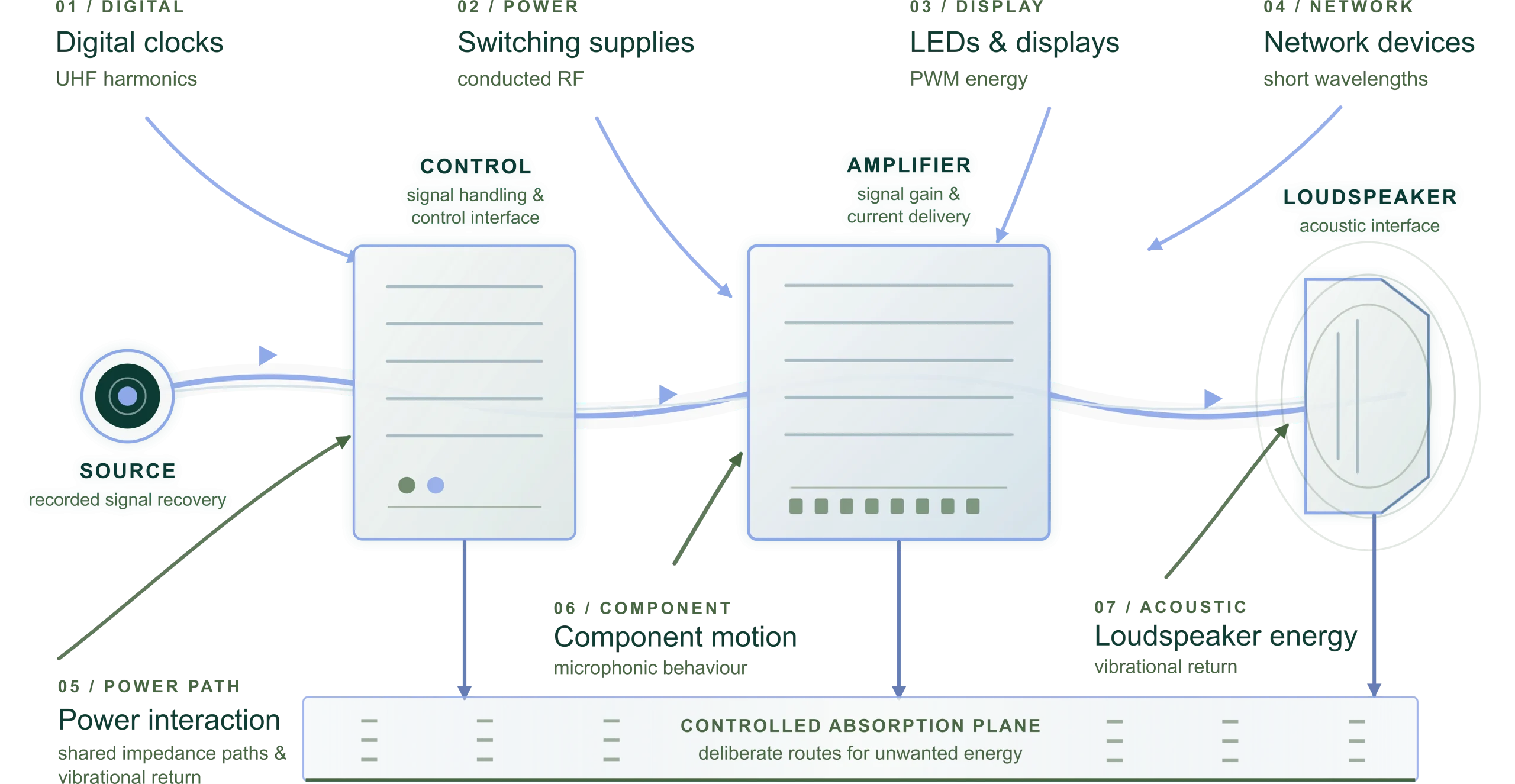
The conventional audio band is commonly described as roughly 20 Hz to 20 kHz. At those frequencies, the wavelength associated with an electrical signal is large compared with many everyday circuit dimensions and cable lengths. This is why audio design can often begin by treating a connection as electrically short.
Modern systems do not operate only in that frequency range. Digital clocks, network equipment, displays, LED drivers, switch-mode power supplies and the audio components themselves can all produce energy at much higher frequencies. As frequency rises, cable geometry, circuit layout, connector interfaces and equipment spacing become more relevant to the route that energy takes.
The resulting disturbance is not necessarily contained inside the device that created it. It may be conducted through mains and connections, radiated into the surrounding space, or coupled into chassis, grounding and signal paths. A system can therefore behave less like a set of independent boxes and more like a shared environment.
Electrical activity has physical effects
Voltage and current do more than pass through circuit symbols. Fields, heat and force can change the physical state of real components.
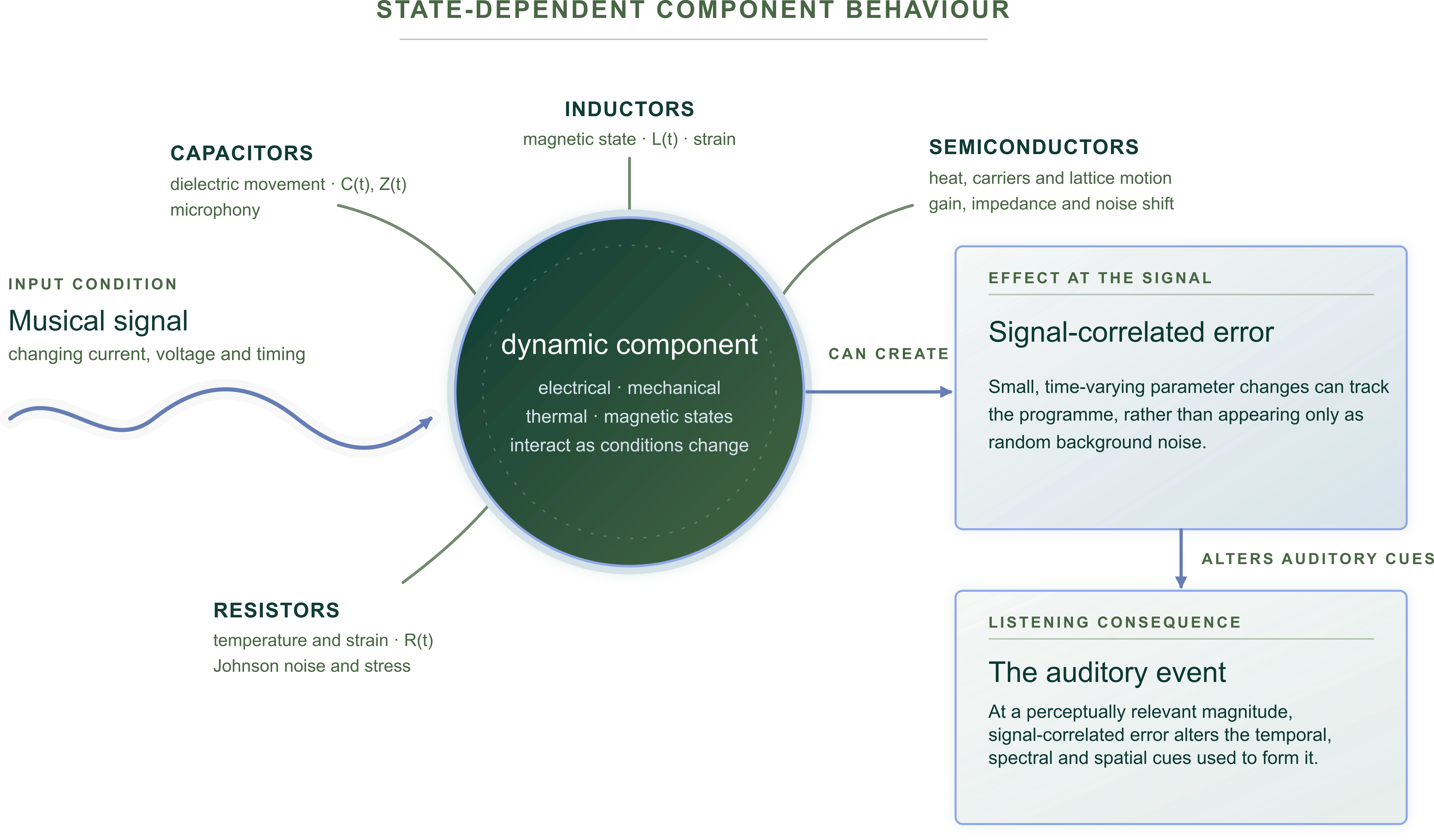
Capacitors, inductors, resistors and semiconductors are often introduced as ideal mathematical parts. In practice, each is a physical structure made from materials, leads, junctions and conductors. Each can respond to electric and magnetic fields, heat and mechanical stress.
That does not make the familiar circuit model wrong. It gives it a range of usefulness. A capacitor also has inductance and resistance; an inductor also has capacitance; a cable and a circuit board have distributed properties rather than behaving as perfect, neutral wires. At higher frequencies those additional characteristics can influence impedance, coupling and the route taken by unwanted energy.
The same applies to mechanical conditions. Vibration, changing current demand and temperature can affect real structures. The Physics of Quiet treats those influences as part of the system context rather than as unrelated background detail.
Conventional filtering remains essential. Capacitors, inductors, careful layout, screening and sensible grounding practice all help control unwanted energy. The point is not that these methods cease to matter. It is that, at sufficiently high frequencies, their idealised behaviour is no longer the whole description.
A capacitor can acquire series inductance and reach self-resonance. An inductor can have parasitic capacitance. A circuit board, cable loom or ground connection can behave less like a simple wire and more like a distributed structure. A treatment that appears to provide a straightforward path at one frequency may behave differently at another.
This is why route and boundary matter. If an impedance transition does not give unwanted energy a controlled path, some energy may be reflected back into the wider system or continue into a region we would rather protect. The companion pages on Return Loss and Insertion Loss examine those two questions separately.
Once the sources and routes are visible, three distinct questions follow. Return Loss concerns energy reflected at a boundary; Insertion Loss concerns energy transmitted through it; Tracking Error asks how closely the output follows a changing musical signal. The first two describe boundary behaviour, while the third turns attention to the signal itself.
The consequence of unwanted energy is not necessarily a simple hiss or buzz. It can be more subtle: conditions that make it harder for a system to preserve changing relationships of level, timing and harmonic structure as music unfolds.
Music is not a steady test tone. It changes continuously in amplitude, transient shape, harmonic content and spatial information. Frequency response, distortion and signal-to-noise ratio remain valuable measurements, but they do not describe every short-term condition within a working system.
The Tracking Error in Audio Systems page uses a conceptual illustration to explore this idea. It does not claim a fixed audible result from any one treatment; it explains why a quieter, more stable environment may give the existing system a better chance to preserve the relationships already present in the recording.
This is why Quiescent treats power, component grounding, interconnects, speaker connection and amplification as parts of one connected system. Each addresses a different route by which unwanted energy may enter, travel through or return around the wider audio environment.
The aim is not to add a house sound or impose a tonal balance. It is to reduce uncontrolled conditions around the signal, so the components already present in the system can operate in a more stable environment. During our development and listening evaluations, reducing unwanted disturbance has repeatedly produced a clearer, more stable musical presentation.
In practice, the relevant route will depend on the system, its equipment, its connections and its surroundings. Explore Quiescent products to see the product families that address those different parts of the connected environment.
The Physics of Quiet is not an argument for removing energy from music. It is an argument for giving unwanted electrical and mechanical energy fewer uncontrolled ways to circulate, return and interfere with the conditions in which music is handled.
When the field around the signal is quieter and more stable, the musical event has less to compete with.
The Physics of Quiet is a starting point. The following pages take individual parts of the system view in turn: how unwanted energy can affect signal tracking, how it reflects at a boundary, how it is reduced as it travels through a boundary, and how a sensitive subsystem can be defined between two controlled boundaries.
Signal behaviour
How a changing disturbance environment can make it harder for a system to follow the musical signal precisely.
Explore Tracking ErrorHigh-frequency behaviour
How high-frequency energy behaves on cables and PCB tracks, and why wavelength, return paths and skin effect matter in audio systems.
Explore High-Frequency PropagationMatrix boundaries
How a controlled boundary reduces the energy reflected back into the system.
Explore Return LossMatrix boundaries
How a boundary reduces unwanted energy that would otherwise pass through and continue onward.
Explore Insertion LossSystem application
How two Matrix boundaries can define a quieter environment around a sensitive part of a system.
Explore Audio Subsystem ProtectionMains and earth
A systems view of balanced supply, transformer coupling and the high-frequency behaviour of earth paths.
Explore Balanced MainsPhysical components
How changing electrical and physical conditions can interact inside real audio components.
Explore Vibration in Audio ComponentsHigh-frequency behaviour
How high-frequency noise in audio circuits can cause disturbance.
Explore RF in Analogue Audio CircuitsSystem Behaviour
Why powering a loudspeaker involves changing current demand, phase and energy returned by driver motion.
Explore Power Amplifier and Loudspeaker LoadsMeasurement and perception
Why a measured signal difference is only the first step in understanding what listeners can hear and judge.
Explore Audio Measurements and ListeningThis page presents a conceptual systems view of high-frequency behaviour in audio equipment. The references below explain the underlying component, coupling and measurement principles; they do not constitute independent performance verification of Quiescent products.
The first two references support the psychoacoustic principle used in the dynamic-component illustration: changes to time, level and coherence-related signal cues change the auditory event experienced by a listener. They do not establish a measured threshold or product-performance outcome for a particular Quiescent system.