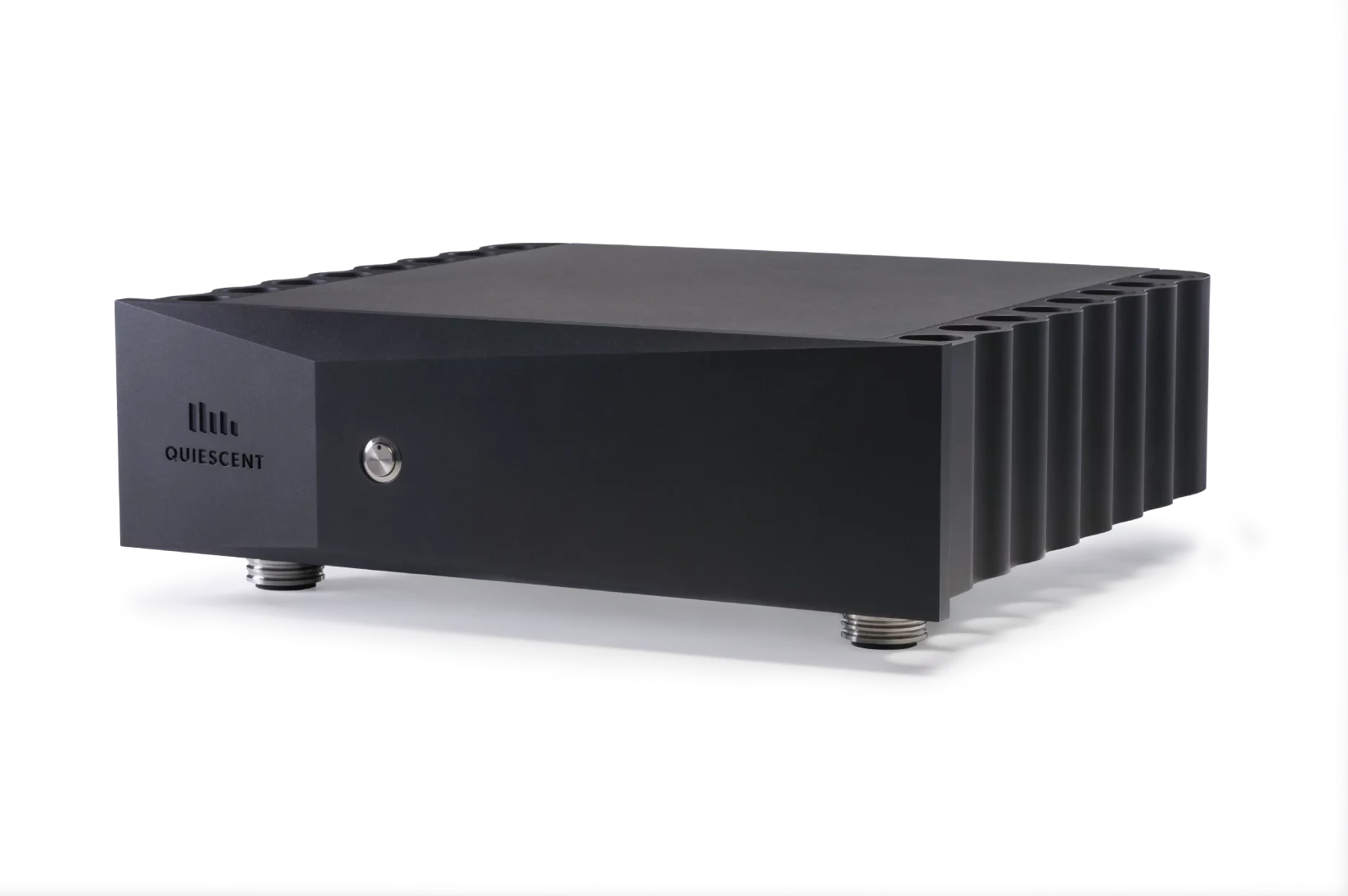
T100SPA Stereo Power Amplifier
The T100SPA stereo power amplifier is designed for listeners who value control without emphasis. Quiescent QPower technology sits at the centre of the design, reducing the electrical and mechanical noise that can obscure timing, tone and recorded space.
Rated at 130W per channel into 8 ohms and 200W per channel into 4 ohms, it combines high bandwidth, adaptive bias control, and a short signal path to provide demanding loudspeakers with a stable, composed source of energy.
Previous
Next
A stereo amplifier with quiet authority
Quiet authority is the aim: not force for its own sake, but a lower-noise platform from which the amplifier can control the loudspeaker without drawing attention to itself.
The T100SPA is powerful enough for demanding loudspeakers, yet its character is defined less by spectacle than by composure. It allows the recording to retain its own balance, space and momentum, with low-level information emerging naturally rather than being pushed forward.
That calmness is not achieved only at the loudspeaker terminals. It begins inside the amplifier, where the power supply, signal input, output stage, heatsinks, and casework are treated as parts of a single quiet electrical and mechanical environment.
Control Without Emphasis
The T100SPA stereo power amplifier is intended for systems where clarity, dynamic control and musical timing matter more than added emphasis. Its high-bandwidth current-feedback architecture and low-inductance MOSFET output modules give the amplifier the speed and current delivery needed to control demanding loudspeakers with composure.
Digitally controlled adaptive bias calibration keeps the amplifier boards operating consistently as mains conditions and operating temperature change. The purpose is not to make the amplifier sound mechanical or over-controlled, but to preserve stability so musical structure remains intact at low and high listening levels.
Quiescent QPower technology supports this performance by reducing the unwanted energy generated around the transformer, rectifier and smoothing capacitors before it can move onward into sensitive amplifier stages.
T100SPA stereo power amplifier architecture
The T100SPA stereo power amplifier uses a short signal path, high-bandwidth current-feedback architecture and adaptive bias control, but its deeper distinction is the way the whole amplifier is treated as an environment for the signal.
Power supply behaviour, mechanical movement, signal grounding, heatsink structure, casework and loudspeaker loading are all considered together. The aim is to prevent each part of the amplifier from passing unwanted electrical or mechanical artefacts to the next.
The same thinking informs the wider T-Series amplifier design and is supported by Quiescent Audio Mains Control and the principles explored in The Physics of Quiet.
Specifications
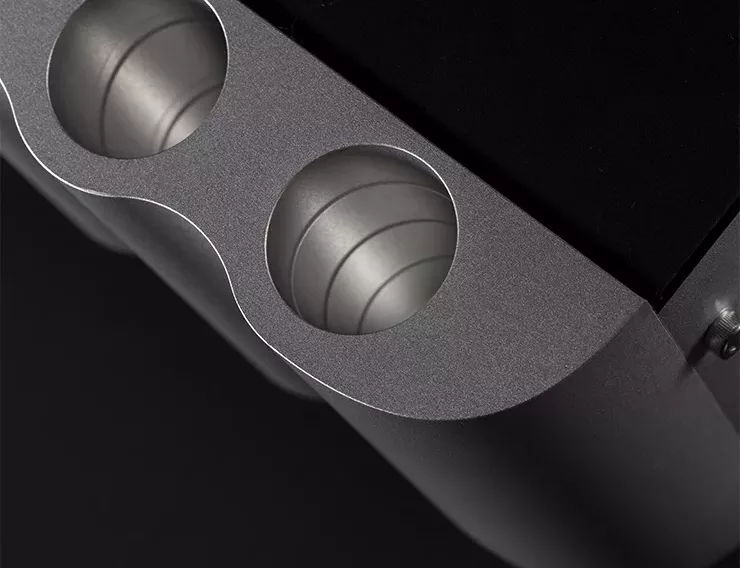
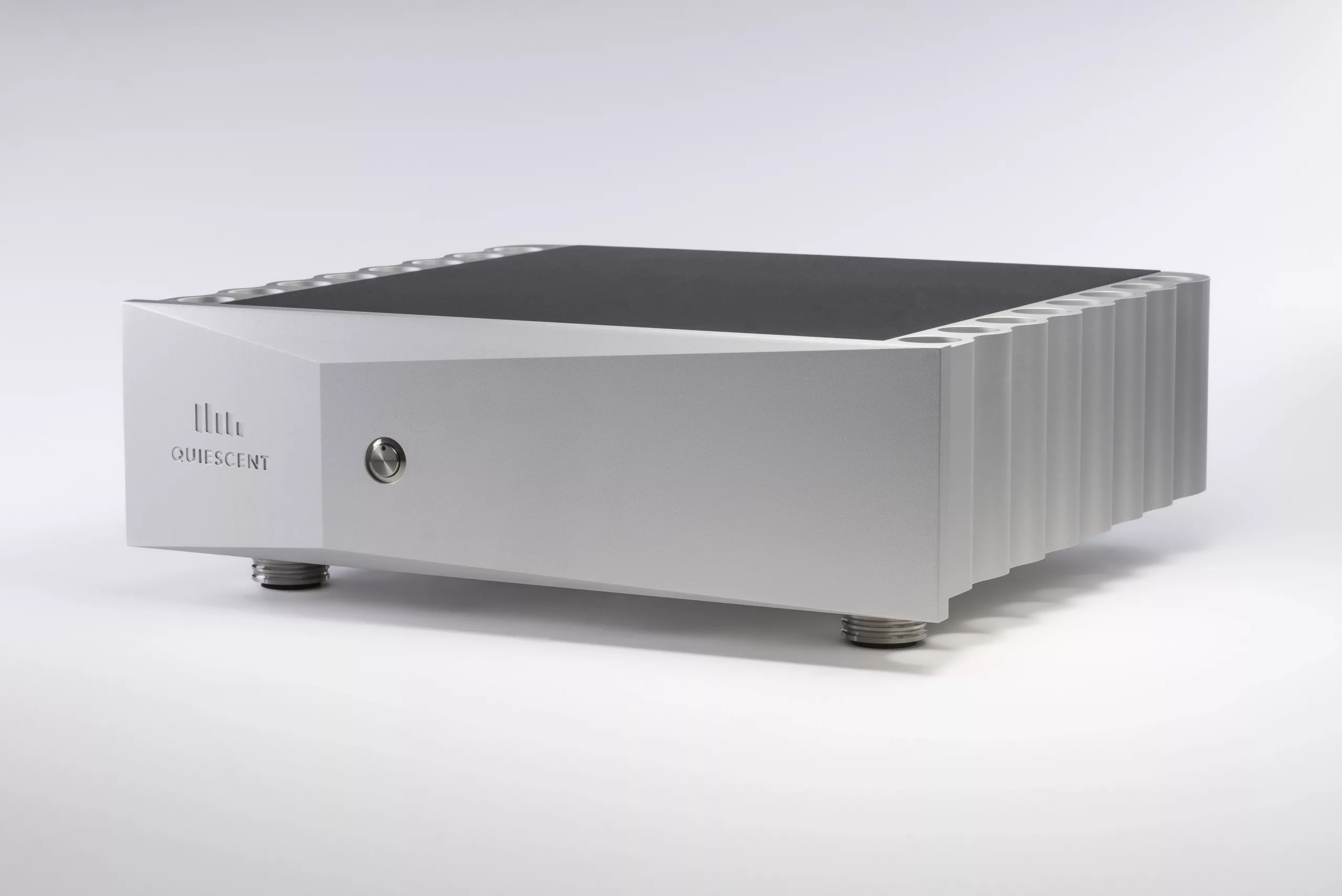
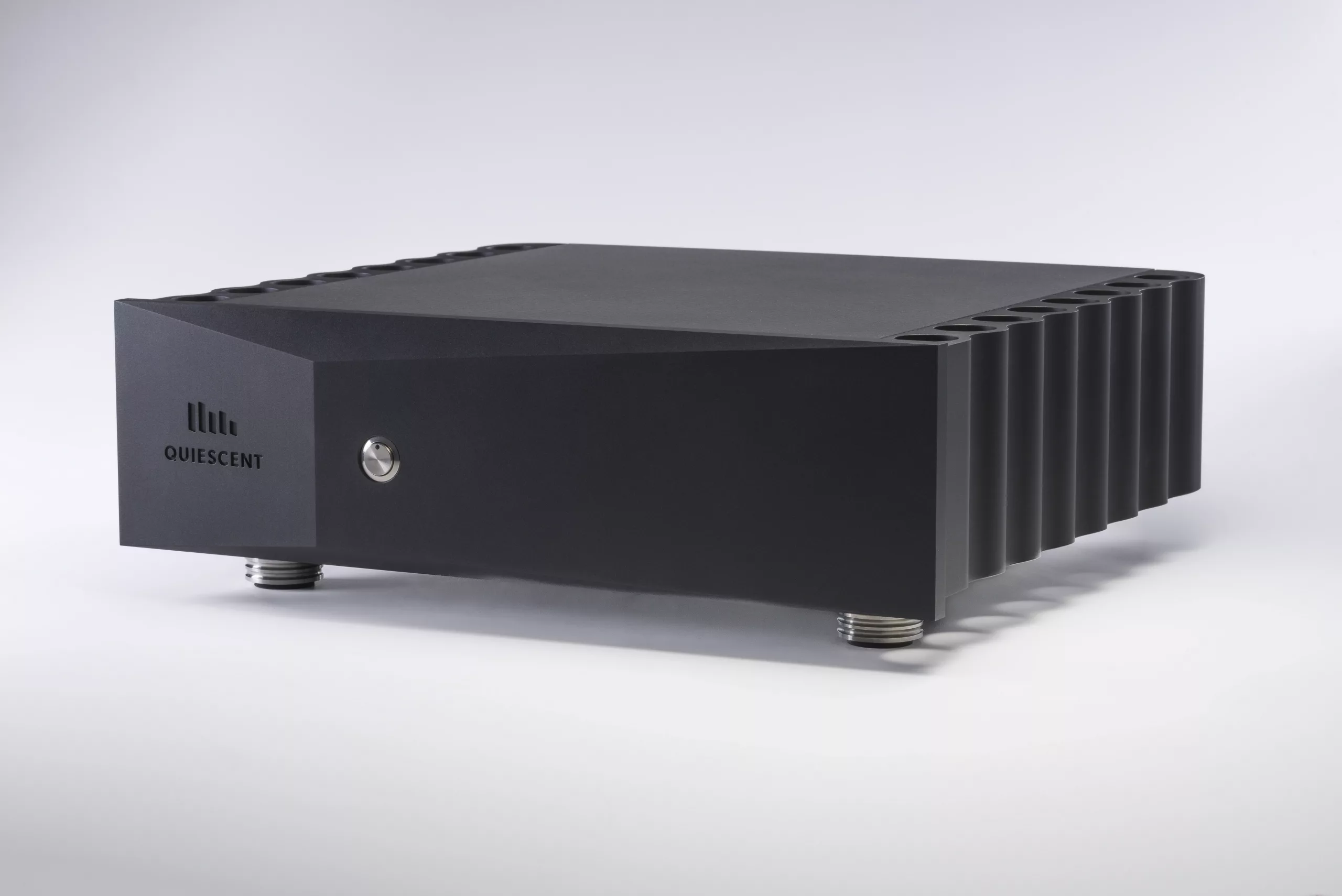
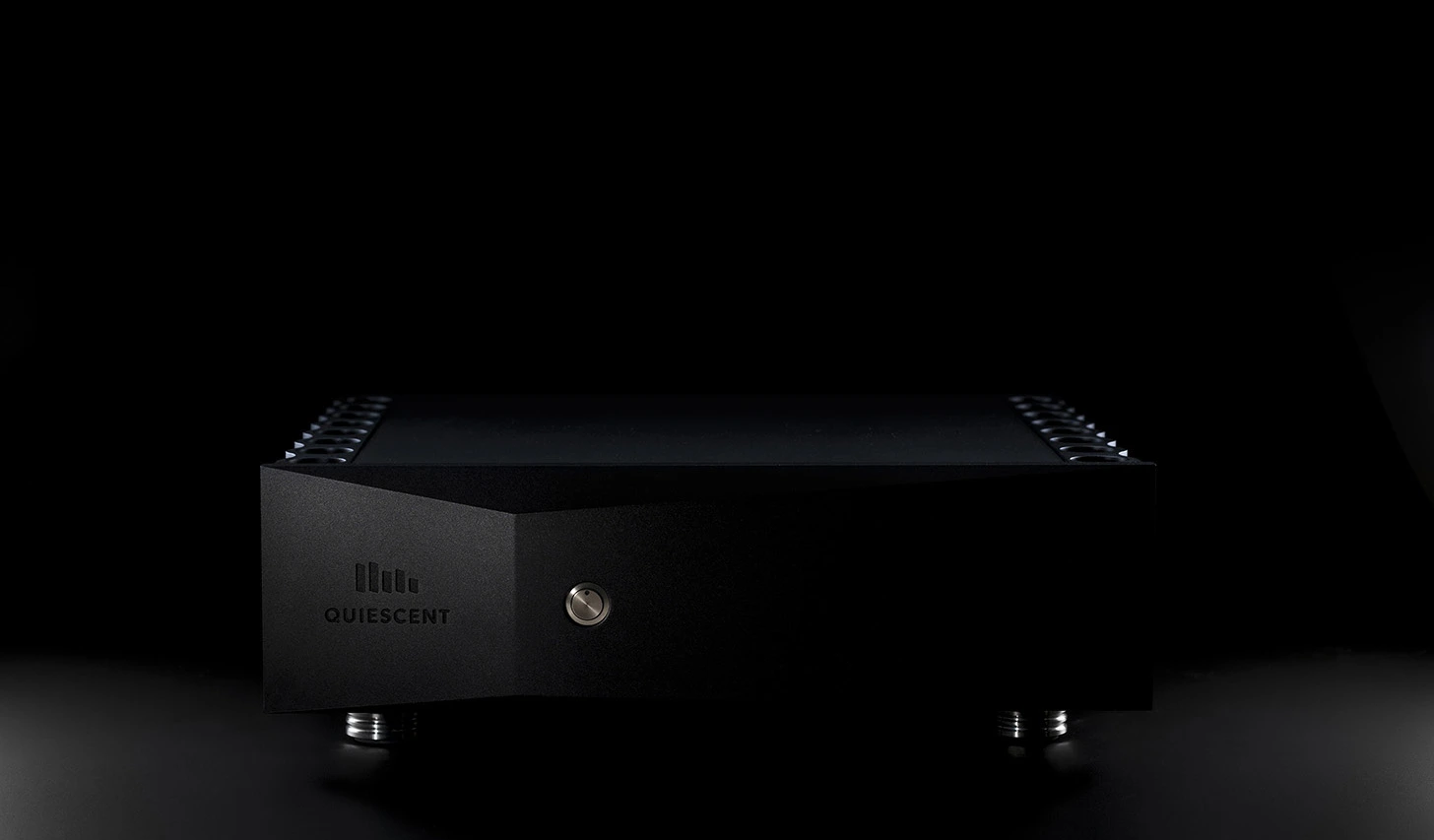
The 27 kg chassis is not simply an enclosure. Its machined casework, vibration-isolated sub-plates and custom passive heatsinks are designed to help manage heat, mechanical energy and electrical behaviour as one system.
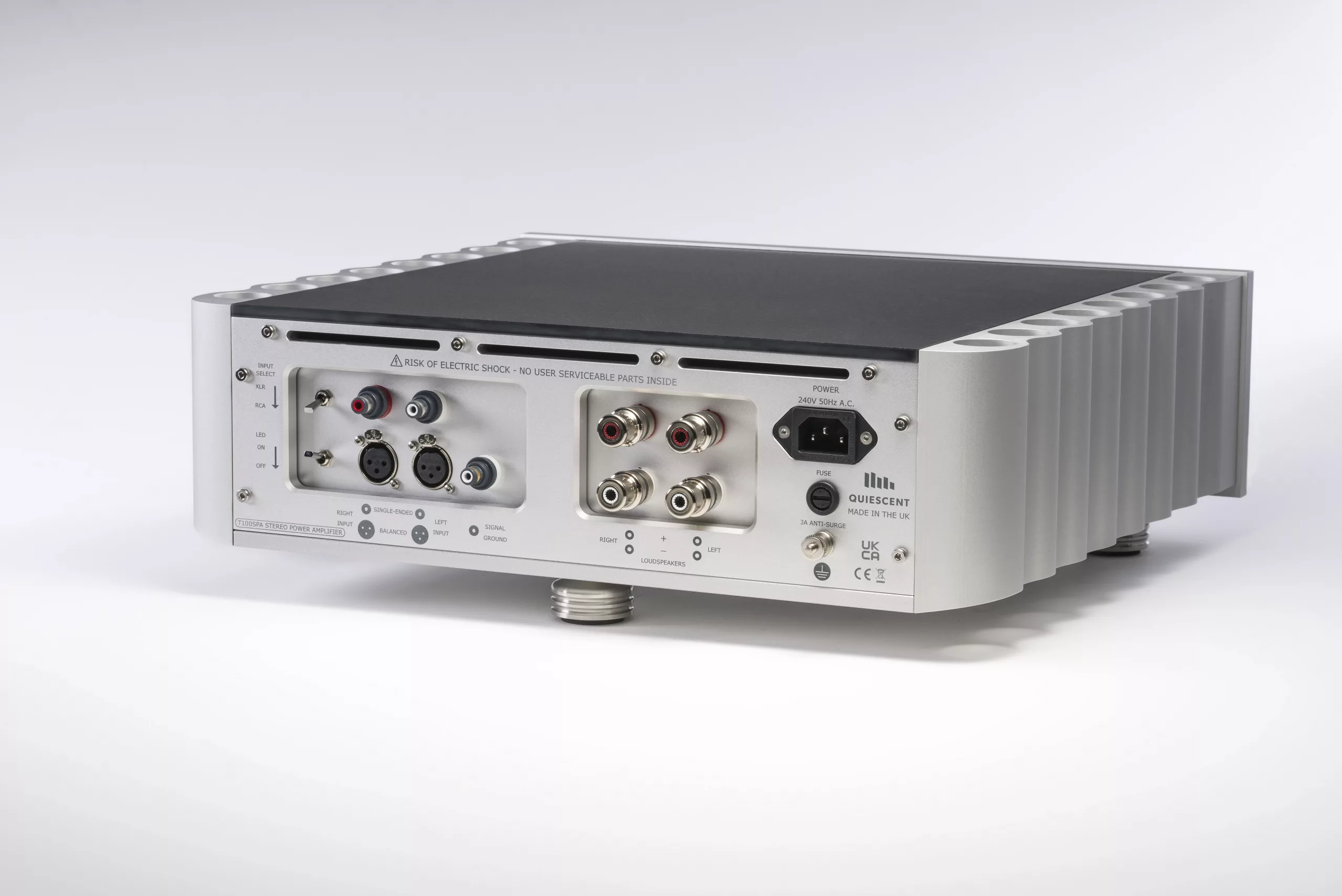
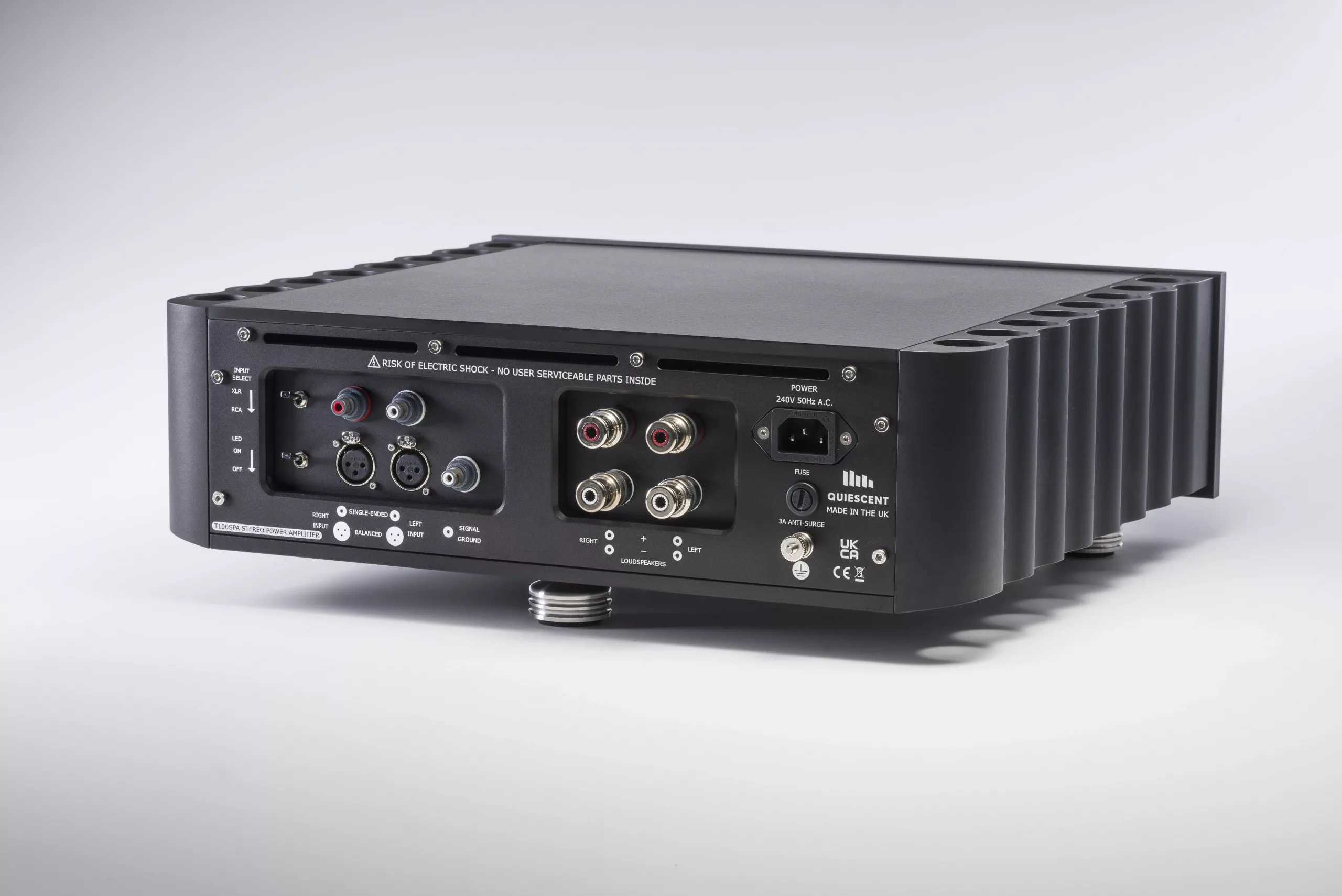
Separate signal-in and signal-out sub-plates reduce vibration cross-contamination between the low-level input stage and the loudspeaker output connections. Silver conductors and connectors are used through the signal path, supporting stable, low-noise transfer into demanding loudspeaker loads.
Every panel is designed and manufactured in-house to the tolerances required for the enclosure to actively contribute to the amplifier’s quietness.
Technology
The Quiescent T100SPA stereo power amplifier is designed as a complete electrical and mechanical system. Peak Mains Modules, Peak Speaker Modules, Apex and Peak mains cables, and Quiescent interconnects address EMI/RFI and vibration as they move between products in a system. The T100SPA applies the same principles inside the amplifier, so each subsystem is less able to pass unwanted artefacts to the next.
That same thinking extends to the amplifier’s internal wiring. Signal, power, and control wiring are routed with Quiescent EMI/RFI absorption tubing, drawing on the same principles used in our interconnect and mains-cable designs, so that internal wiring is less likely to act as a path for unwanted high-frequency energy.
The aim is not to add a character of its own. It is to reduce the opportunities for mains disturbance, transformer vibration, rectifier noise, capacitor movement, signal-ground behaviour, heatsink resonance and loudspeaker-load reflection to modulate the music.
QPower: from mains input to stored energy
Quiescent QPower technology treats the power supply as part of the musical signal environment, not simply as a source of voltage. Mains input, transformer behaviour, rectification and smoothing are each managed through controlled pathways and dedicated absorption matrices, helping unwanted electrical and mechanical energy dissipate before it can reach the amplifier stages.
Before the mains reaches the transformer primary, it passes through an adapted Peak Module with DC blocking. This gives incoming DC offset and high-frequency disturbance a defined place to go before they are presented to the primary windings.
The transformer is then treated as both an electrical and mechanical source of energy. It is given pathways through the mechanical fixing bolt and through the centre taps on the primary and secondary windings, reducing the opportunity for high-frequency electrical energy and mechanical vibration to circulate through the amplifier structure.
Rectification and reservoir control
The transformer outputs pass into a dedicated full-wave bridge rectifier mounted on its own absorption matrix. This matters because rectification is one of the places where high-current switching behaviour can generate unwanted high-frequency energy near the amplifier’s power rails.
The large smoothing capacitors that follow are also mounted on their own dedicated matrix. Their role is to store and release energy for the amplifier, but they are also physical components with mechanical behaviour. Treating them locally helps reduce the path through which vibration and high-frequency artefacts can propagate into the amplifier boards.
Signal input and grounding
The signal from the preamplifier passes through an absorption module before reaching the amplifier’s input stage. This gives unwanted high-frequency energy around the input a controlled place to go without placing a conventional tonal filter in the signal path.
Quiescent does not use the power amplifier input as the default place to drain or define signal ground. In most systems, the safest and quietest place to establish that reference is the preamplifier. For preamplifiers with a floating ground, the T100SPA provides a separate signal-ground connector so the reference can be supplied deliberately, rather than forced through the audio input itself.
Output modules and the loudspeaker load
A loudspeaker is not a passive destination. Its drivers, crossover, cabinet and speaker cable can return mechanical vibration and high-frequency electrical energy toward the amplifier.
For this reason, the outputs from the amplifier boards pass through dedicated modules before reaching the loudspeaker terminals. Their role is to reduce the opportunity for EMI/RFI and vibration from the speaker load to reflect back into the amplifier circuitry.
This links the T100SPA directly to the thinking behind Quiescent Speaker Connection products. The amplifier and the loudspeaker are treated as a coupled system, not as isolated parts joined only by a cable.
Heatsinks as absorption structures
The T100SPA uses custom-designed passive heatsinks. Their primary role is thermal, but their geometry is also part of the mechanical design.
The heatsinks are crafted with non-parallel faces to discourage simple vibration reflection back into the amplifier boards. Instead of treating cooling as a separate requirement, Quiescent uses the heatsink’s mass and shape as part of the amplifier’s absorption strategy.
Isolated input and output plates
The signal input and loudspeaker output are mounted on separate vibration-isolated sub-plates. This minimises mechanical cross-contamination between the low-level input area and the higher-energy output connection to the loudspeaker.
Small-signal information and loudspeaker current are therefore kept physically and mechanically distinct. The arrangement supports the same principle used throughout the amplifier: each transition point is controlled so energy does not move freely where it is not wanted.
LED control and the ground plane
The front-panel LED indicator is defeatable. This may seem like a small detail, but LEDs and their drive circuits can introduce unwanted high-frequency activity into the local electrical environment.
When the LED is switched off for serious listening, another possible source of EMI/RFI activity on the ground plane is removed.
Casework and RF behaviour
The non-metallic top plate is part of the amplifier’s RF strategy. A fully enclosed metal chassis can behave as a Faraday enclosure: useful for screening, but also capable of retaining radio-frequency energy inside the product if there is no controlled gap or lossy route for that energy to leave.
The T100SPA avoids treating the chassis as a sealed RF cavity. Its casework, non-metallic top plate and internal absorption areas are designed to reduce trapped high-frequency energy while preserving the physical discipline expected of a high-performance amplifier.
For readers wanting the engineering background, this relates to Faraday enclosure behaviour and how shielded metal structures manage, leak, or retain high-frequency electromagnetic energy.
Internal absorption lakes
Separate EMI/RFI absorption lakes are used inside the case for the transformer and each amplifier board. These local absorption areas are positioned close to the parts of the amplifier most likely to generate, receive or pass on unwanted high-frequency energy.
This is the internal expression of the wider Quiescent approach. Rather than allowing unwanted energy to move freely around the product and asking one final stage to deal with it, the T100SPA addresses disturbance locally, repeatedly and quietly.
The system result
The T100SPA stereo power amplifier is not quiet because one isolated part has been improved. It is quiet because the amplifier is treated as a set of related electrical and mechanical environments.
Mains input, transformer, rectifier, reservoir capacitors, signal input, amplifier boards, heatsinks, chassis and loudspeaker outputs are each given controlled behaviour. This helps the amplifier remain composed under real system conditions, allowing timing, tone, image stability and recorded space to emerge without unnecessary emphasis.
Specifications
Audio Outputs
Minimum Load Impedance
2Ω
Power Output (rms)
130W per channel into 8Ω
200W per channel into 4Ω
Gain
26.5dB
Frequency Response
-3dB at 0.5Hz to 600kHz
Slew Rate
91V/us
THD @24W output into 8Ω load
(1kHz sinusoidal signal)
0.03%
S/N Ratio
120dB
Terminals
WBT nextgen™ Ag Silver conductor binding posts
Audio Inputs
Impedance
10kΩ
Sensitivity
1.6V
Sockets
2 x WBT nextgen™ Ag Silver conductor phono or 2 x silver conductor XLR (switchable)
Grounding
Chassis
M5 Binding post on rear panel
Signal
RCA socket on rear panel
Casework
Finish
Bead blasted natural or black anodised high grade aluminium with high-impedance
non-metallic top
Cooling
Passive custom-built heatsinks
Dimensions (HxWxD)
140 x 440 x 400mm
Weight
27kg
Power
Input
230V, 50Hz