Return Loss in Audio Systems
Traditional thinking considers a hi-fi system as a chain: source, amplifier, cables, loudspeakers and room. That picture is useful, but it leaves out the environment around the music signal. Power supplies, grounding paths, cable screens, chassis structures and nearby digital devices can all carry unwanted high-frequency energy.
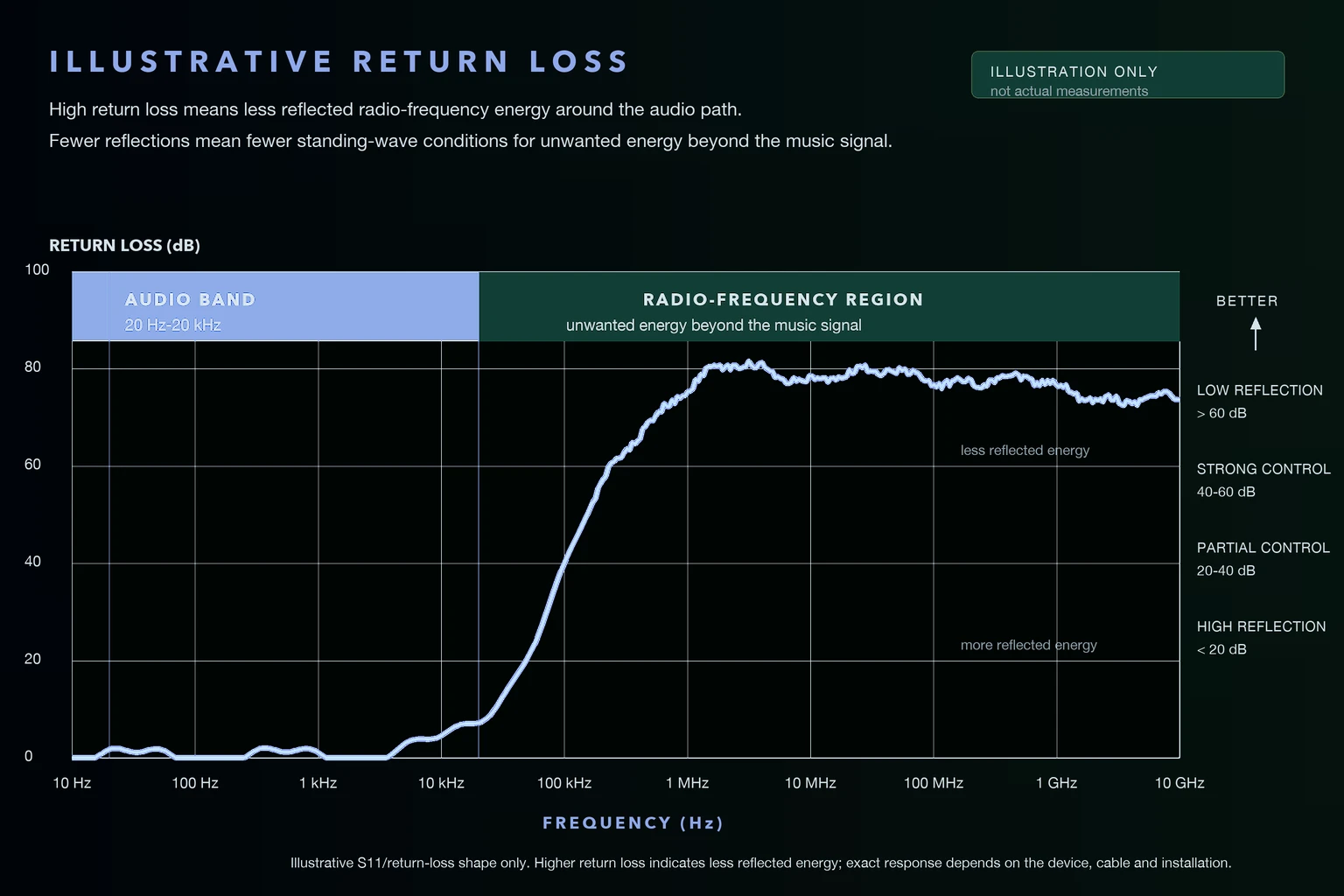
Return loss is one way of describing how well that unwanted energy is prevented from reflecting back into the system. In simple terms, high return loss means less reflected energy. Low return loss means more energy is being sent back along the path, where it can create standing-wave conditions and interact with the system in ways the music signal never asked for.
How To Read The Illustration
The illustration shows the principle behind return loss. The audio band is shown at low frequencies, while the radio-frequency region sits well above the musical signal. The rising curve is not a measured Quiescent product response. It simply shows the desired direction of travel: higher return loss in the unwanted high-frequency region means less reflected energy returning to the system.
The exact response of any real installation depends on the product, cable, equipment, grounding arrangement and surrounding noise environment. The useful idea for the listener is simple: less reflected high-frequency energy means fewer uncontrolled conditions around the audio path.
What Quiescent Is Trying To Control
Quiescent products are designed around the whole audio system, not only the individual box or cable. That is why return loss in audio systems is a design fundamental for all our products. The aim is to give disruptive electrical and mechanical energy controlled routes away from the signal, reducing the opportunity for reflected energy, standing waves and signal-correlated disturbance to influence the listening experience.
This is not about adding a tonal signature. It is about reducing unwanted influence so the components already in the system can work in quieter, more stable conditions. When that environment improves, the listener should hear more of the musical event itself: clearer starts and stops, more natural decay, stronger spatial relationships and a calmer sense of presence.