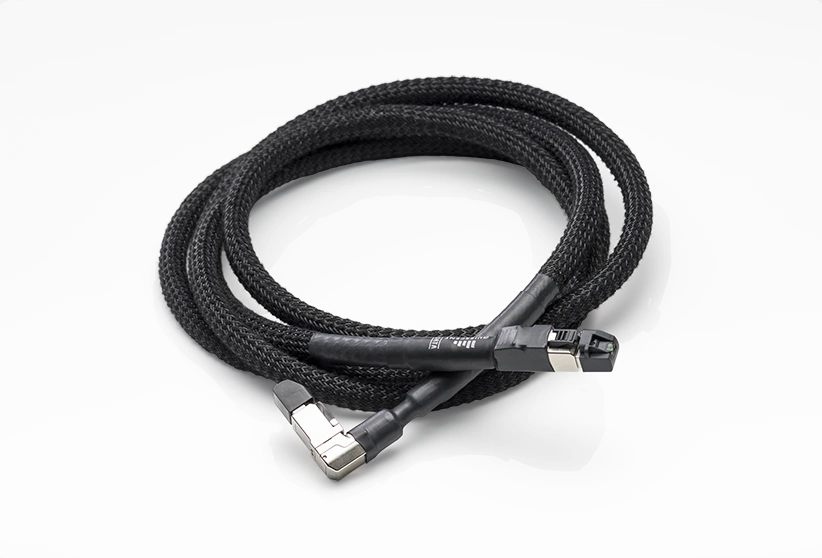
DATA Digital LAN Cables
Network cables engineered for quiet streaming.
DATA Digital LAN Cables are designed for high-performance music and cinema systems where network connections are part of the signal environment.
They preserve Ethernet performance while reducing the high-frequency electrical and mechanical energy that can radiate from routers, switches, and network storage into sensitive streamers, servers, and DACs.
Previous
Next
Quiet streaming, stable timing
Ethernet data is robust, but the equipment that receives it is still an analogue electrical system. Network cables carry fast transitions, return currents, and common-mode energy, as well as packet data, and these conditions can influence the environment in which clocks, receivers, and DAC interfaces operate.
DATA Digital LAN Cables are designed to reduce unwanted energy without compromising network performance. The result is not a cable that changes the data into something else, but a quieter network link that helps streaming components work with greater stability, spatial clarity and ease.
In music and cinema systems, that quieter environment can also support a calmer picture path, with image stability, contrast, and low-level detail emerging more naturally.
Designed around the behaviour of high-frequency energy
At high frequencies, an Ethernet cable behaves as a distributed transmission line. Geometry, twist consistency, dielectric behaviour, connector quality and RF absorption all influence how energy is carried, reflected or dissipated.
DATA Digital LAN Cables use Cat6A UTP solid-core OFC conductors, low-loss dielectric materials, proprietary EMI/RFI absorption tubing and acoustic damping to reduce unwanted propagation around the network connection.
This follows the principles explored in The Physics of Quiet: reduce the noise field around the electronics without placing treatment in the signal path.
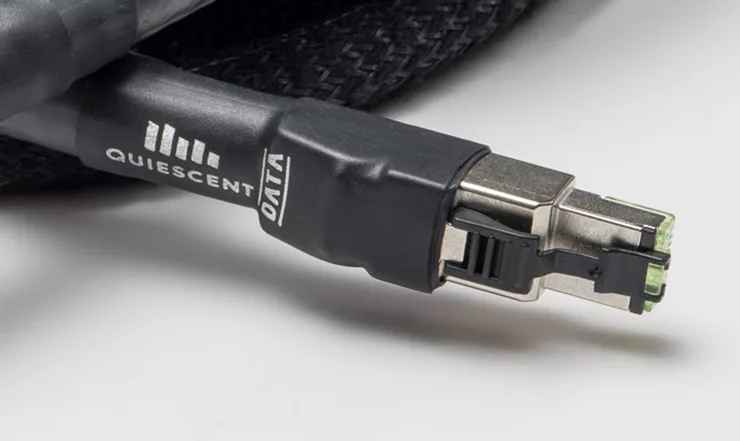
Cat6A construction, Quiescent control
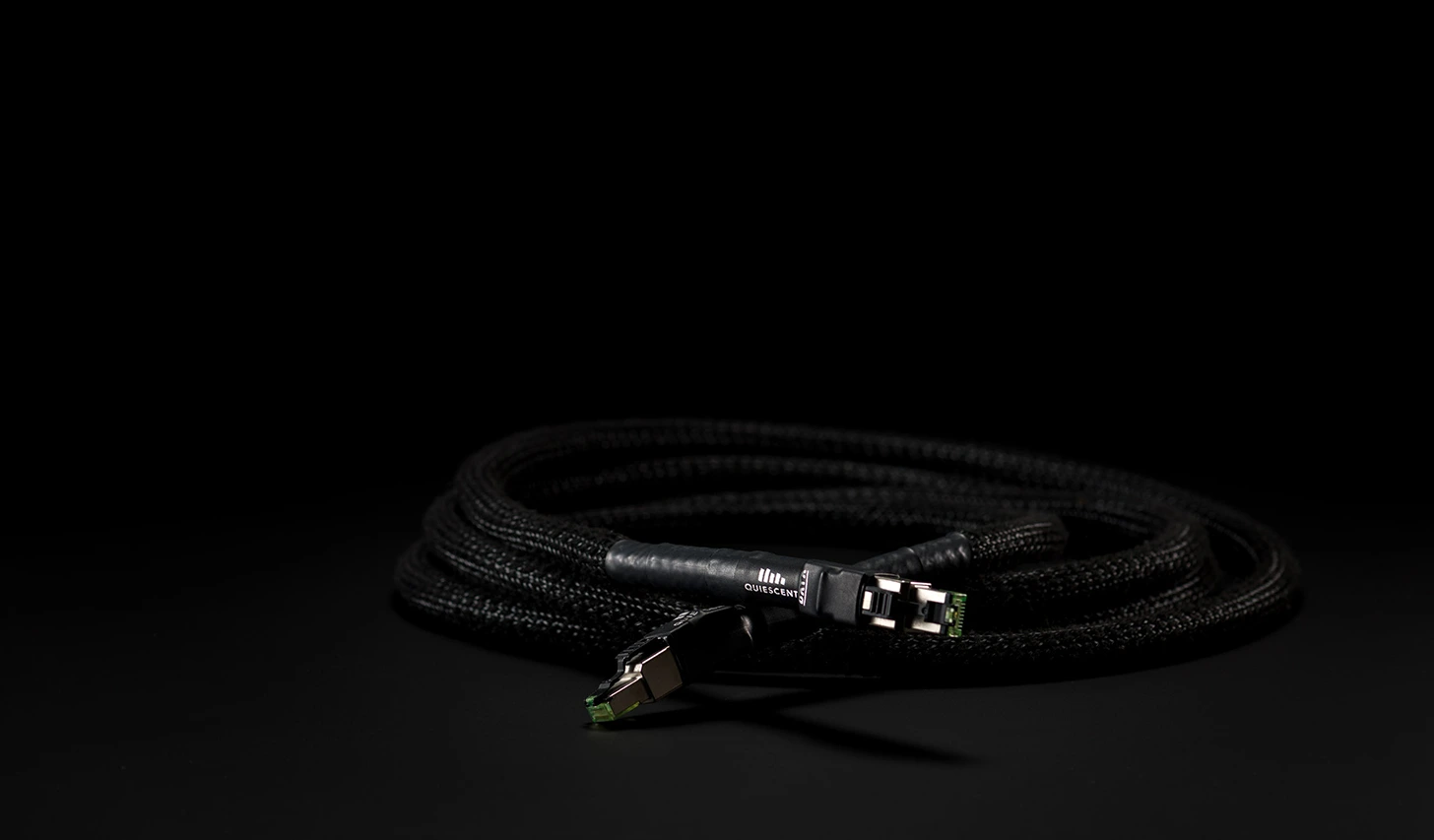
DATA Digital LAN Cables are Cat6A UTP cables using eight solid-core oxygen-free copper conductors, low-capacitance construction, proprietary EMI/RFI absorption tubing and ABS acoustic damping outer braid.
A quieter Ethernet link for high-end audio
The network cable as part of the signal environment
DATA Digital LAN Cables are based on the understanding that network audio is not separated from the physical system that carries it. The data protocol may be robust, but the streamer, switch, server and DAC remain sensitive electronic devices connected by conductors, dielectrics, grounds and mechanical structures.
Routers, switches and network storage can generate high-frequency energy. That energy can travel along the cable structure even when the packets themselves are correctly delivered. The design question is therefore not only whether the data arrives, but also what electrical and mechanical conditions accompany it.
Transmission-line behaviour
At Ethernet frequencies, the cable behaves as a distributed transmission line. Twist geometry, conductor spacing, dielectric behaviour, and connector termination influence impedance continuity, return loss, and how unwanted energy is reflected or dissipated.
DATA Digital LAN Cables use Cat6A UTP solid-core oxygen-free copper conductors and carefully controlled construction to support stable data transmission while avoiding a heavy conventional shield connected to the network ground.
Absorption rather than added shielding
Conventional shielding can block or redirect some external interference, but it can also provide another route for RF energy to move around the system. Quiescent instead uses proprietary EMI/RFI absorption tubing around the cable structure to give unwanted high-frequency energy a more controlled destination.
This is not intended to alter Ethernet data. It is intended to reduce the noise environment around the devices that generate, receive and reclock that data.
Mechanical quietness
A LAN cable is also a physical structure. Movement and vibration can modulate the cable’s distributed properties and can provide another path for mechanical energy between network equipment and audio electronics.
The ABS acoustic damping outer braid is used to reduce mechanical propagation along the cable, supporting the electrical work done by the conductor geometry and absorption system.
The listening result
The intended result is quietness without editorial character. Streaming feels more settled, spatial relationships are easier to follow, and low-level information is less masked by non-musical energy moving around the network interface.
The wider behaviour of high-frequency energy in connected audio systems is explored in The Physics of Quiet.
Specifications
Conductors
Eight solid core solid oxygen-free copper conductors
Capacitance
300 pF/100m
Transfer rate
1 Gbit/s
Bandwidth
500 MHz
Shielding
Quiescent proprietary EMI/RFI absorption tubing
Braiding
ABS acoustic absorbant outer braid
Connectors
Straight or 90° angled zinc die-cast RJ45 Cat6A Connectors with gold-plated contacts
Length
1m and then 0.5m increments up to 10m