Foundation
The Physics of Quiet
The connected electrical and mechanical environment around the music signal.
Explore The Physics of QuietTHE PHYSICS OF QUIET / 11
A measured difference is a question for hearing, not a verdict on music.
An audio system can change a signal in ways an instrument can detect. The next question is whether people can hear that change in music, and whether it alters the presentation they value.
This page brings signal comparison, hearing research and Quiescent’s development experience together to explore how changes in system behaviour relate to musical presentation.
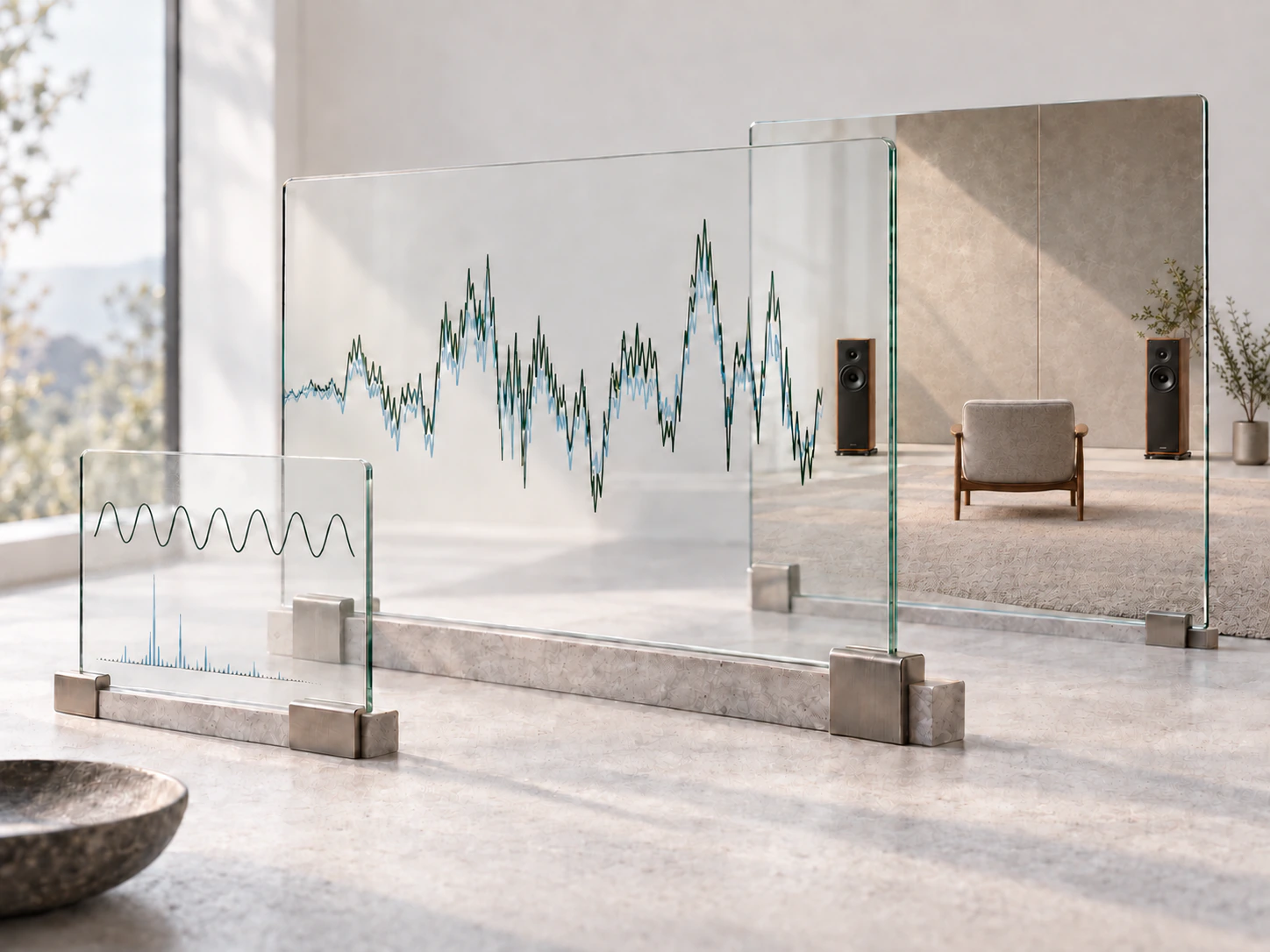
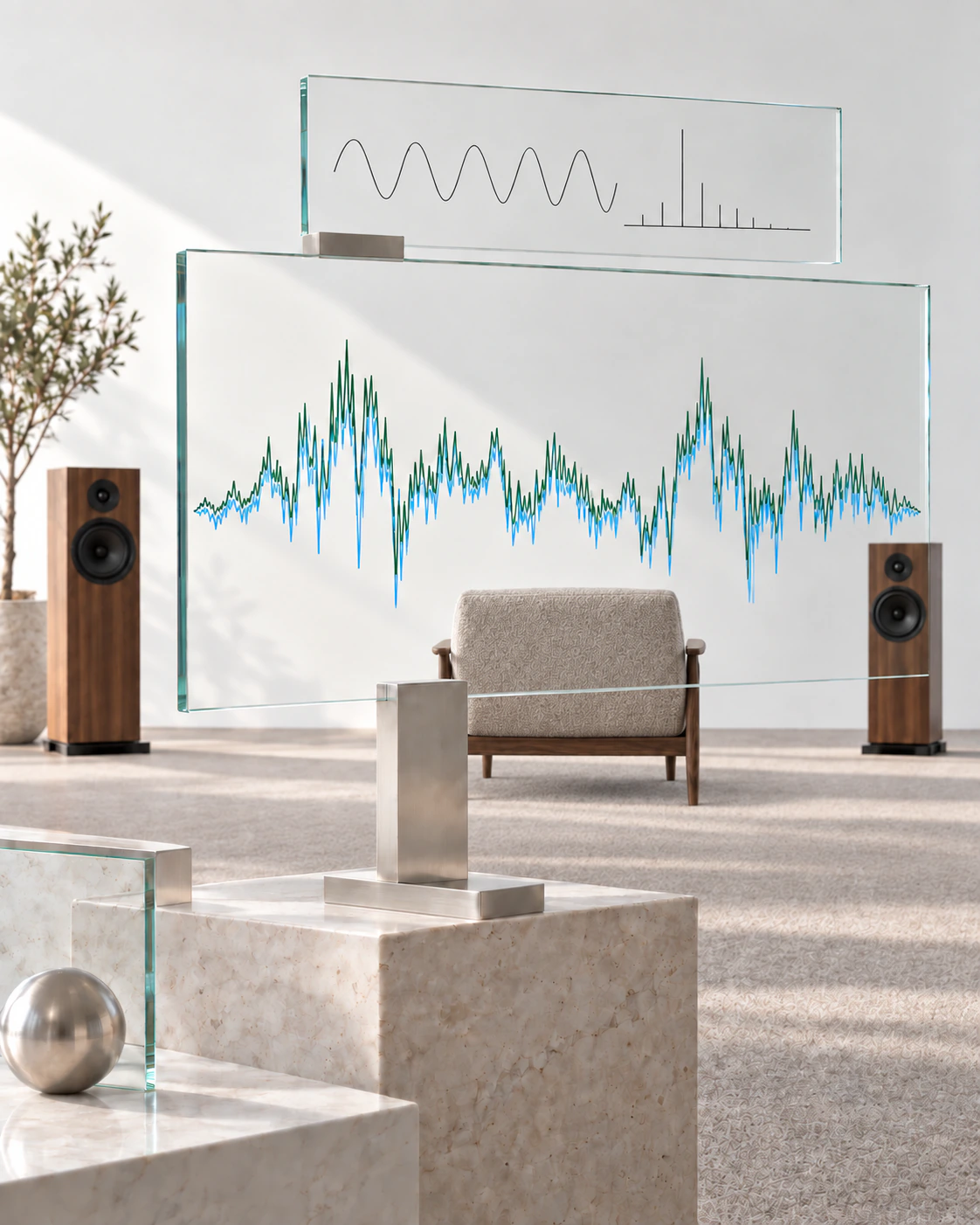
A measurement can tell us that an output differs from a reference and help us locate the difference in level, spectrum, timing or waveform shape. It cannot, on its own, tell us whether that difference is heard during music.
Even reliable detection is a separate question from preference or fidelity. Someone may hear two presentations as different without preferring either; a preferred presentation is not necessarily a closer reproduction of the recording. We therefore ask three questions in order: What changed? Can it be heard? What does it mean to the listener?
Illustrative comparison
First compare the reference and captured output before alignment. Then remove the fixed delay to inspect the differences that remain in level and shape.
Signal comparison
Difference between signals
Enlarged vertical scaleTime
Before alignment, an ordinary fixed delay adds to the difference. Level and shape changes are also present.
Illustrative signal comparison. Removing the fixed delay reveals the remaining differences in level and shape. The lower trace is enlarged vertically to make its structure visible.
Removing a fixed delay is a preparation step, not a way of making an imperfect output perfect. The aligned result can still differ in level, harmonic balance, transient contour and other features of a changing signal. Those differences can be examined with music as well as conventional test signals.
Comparison is only trustworthy when the recording and capture paths, gain, conversion, alignment and repeatability are controlled. A difference trace reveals where two signals diverge. It does not automatically identify the physical cause, nor does its visual size equal perceptual importance.
Nordost and Acuity explored a time-domain comparison between a known musical source and a captured player output. Their approach directs attention to how an output follows a changing passage, rather than relying only on steady test tones. The published examples show an aligned difference trace and discuss apparent time displacement within it.
This approach makes changing signal behaviour available for closer examination. Interpreting the difference requires care: changes in level or waveform shape can resemble time displacement. The white paper provides an exploratory measurement method; establishing how its results relate to audibility requires listening evidence.
Reference-to-output comparison identifies changes in the musical signal. Hearing research helps us interpret their significance: how sounds form a coherent auditory scene and under what conditions listeners detect a difference.
Blauert and Jekosch distinguish the detection of sound attributes from the way a listener forms an auditory scene. Loudness, timbre and spatial cues can be studied separately, but ordinary listening also joins sounds into instruments, locations and a coherent musical event. The importance of a particular cue depends on the material, the task and the listener.
This gives measurement a clear purpose: identify changes in the signal and connect them to the attributes and musical relationships listeners perceive. A specification and a listening evaluation describe different aspects of the same system.
Toole and Olive’s work on resonance shows why a single measured deviation is not a universal hearing threshold: audibility changes with the resonance’s frequency, strength and duration, as well as programme material, loudspeaker behaviour and listener hearing. In another area, Reiss’s analysis of high-resolution-audio listening studies found a small but statistically significant ability to distinguish formats overall, particularly with training.
Audibility depends on the level and structure of the change, the programme material, the listening conditions and the listener. These factors guide both the measurement and the listening evaluation.
A listener may reliably distinguish two systems yet have no preference. Preference can depend on attributes such as spatial impression as well as distortion or bandwidth, and can vary with programme and experience. A report should therefore say whether it tested detection, preference, or a particular quality such as image stability—not use these words interchangeably.
“More realistic” needs an agreed reference. A recording is already a crafted presentation, and the sound of a live performance is not directly recoverable from an electrical output trace. The clearest fidelity claim is about preserving the chosen recording or reference under stated conditions.
When the claim is that a small system change can be heard, use level-matched, repeatable comparisons with appropriate music and listeners. Control presentation order and expectation. For subtle impairments, formal methods such as ITU-R BS.1116 provide a framework for trained listeners and hidden references; broader sound-quality questions call for methods suited to their purpose.
Measurements remain essential for finding, explaining and improving behaviour. Listening tests establish whether a specified difference reaches perception in the tested conditions. Both forms of evidence become more useful when their limits are stated plainly.
The Physics of Quiet begins with energy moving through a connected system and ends with the listener. A better engineering question is not simply “Did the trace change?” but “What changed, under what conditions, and does that change matter to hearing?” Careful measurement and careful listening answer different parts of the same question.
During our development and listening evaluations, reducing unwanted disturbance has repeatedly produced a clearer, more stable musical presentation.
These observations inform our engineering investigations. Measurements help us examine the physical changes; listening evaluations assess their significance in music. Together, they guide development and help us understand which conditions matter in a working system.
Return to the system view, examine why structured error deserves attention, or see how components respond to changing physical conditions.
Foundation
The connected electrical and mechanical environment around the music signal.
Explore The Physics of QuietSignal behaviour
Why an error that follows changing programme conditions deserves examination.
Explore Tracking Error in Audio SystemsPhysical mechanisms
How changing electrical and physical conditions interact in real components.
Explore Vibration in Audio ComponentsThe diagram uses synthetic signals to explain a comparison method. It does not reproduce published measurement data, establish an audibility threshold or measure a Quiescent product. Nordost and Acuity’s published work is cited as an exploratory manufacturer case study, not as independent proof that a displacement measure predicts musical preference.