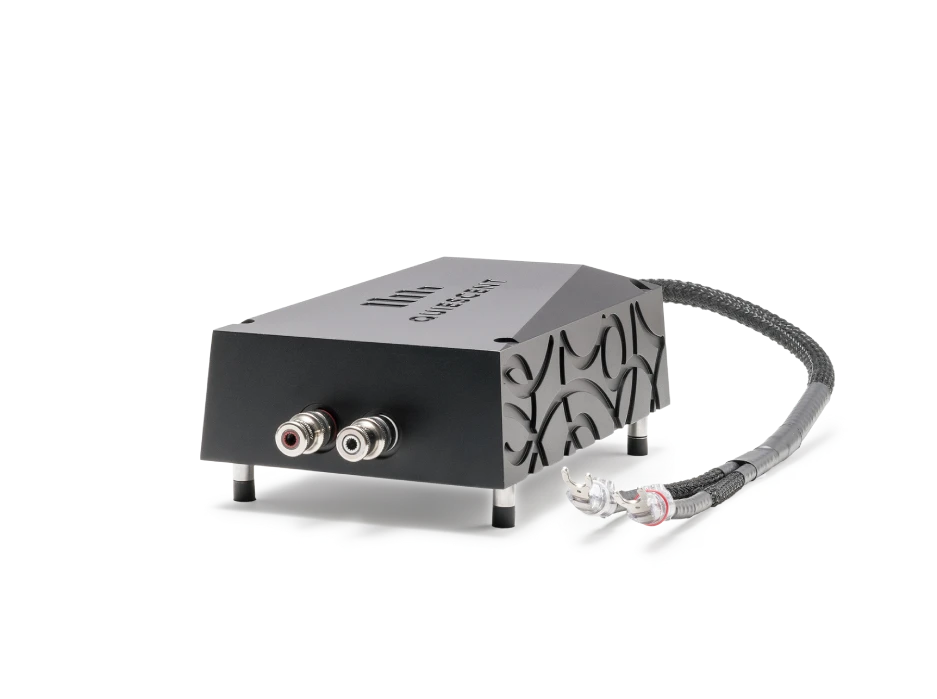
Peak Speaker Modules
Speaker connection control for the energy returning from the loudspeaker.
Peak Speaker Modules are designed for the overlooked path between the loudspeaker and amplifier. While much attention is given to vibration entering electronics through the rack or room, the speaker cable itself can provide a far more direct route back into the amplifier.
Installed at the loudspeaker, and optionally at the amplifier, Peak Speaker Modules absorb high-frequency mechanical vibration and EMI/RFI energy carried by the speaker connection, helping the amplifier work from a quieter, more stable load environment.
Previous
Next
Peak Speaker Modules for a quieter amplifier load
A loudspeaker does not only receive energy from an amplifier. As its drivers move, its cabinet, crossover and internal wiring generate mechanical energy of their own. Some of that energy can return through the speaker cable, reaching the amplifier output stage through a solid, conductive path.
The crossover is part of this return path. Its capacitors, inductors, resistors and internal wiring are exposed to powerful mechanical movement and high-frequency electrical energy inside the loudspeaker, so they too can contribute noise and vibration back into the speaker connection.
Peak Speaker Modules are designed to reduce that return path. By absorbing high-frequency mechanical vibration and EMI/RFI energy at the speaker connection, they reduce conditions that can create microphonic noise in sensitive electronics.
The result is not a change in tonal balance, but a quieter relationship between loudspeaker and amplifier: cleaner timing, more stable images, reduced hardness and a greater sense of ease as musical complexity increases.
Hi-Fi+ described a system equipped with Couplers and Speaker Modules as transformed in every dimension.

 Read the Hi-Fi+ review
A controlled path for speaker-cable energy
Peak Speaker Modules apply the same Quiescent system thinking used in the Peak Mains Module: unwanted energy should be given controlled paths for absorption and dissipation, rather than allowed to reflect through the connected system.
In the speaker connection, this means addressing two behaviours at once. Mechanical vibration can travel back from the loudspeaker through the cable. High-frequency electrical energy can also move along the same connection, creating standing-wave behaviour and conditions for modulation around the musical signal.
The module’s wide-band absorption matrix and low-resonance casework are designed to reduce both mechanisms without placing a conventional filter in the loudspeaker signal path.
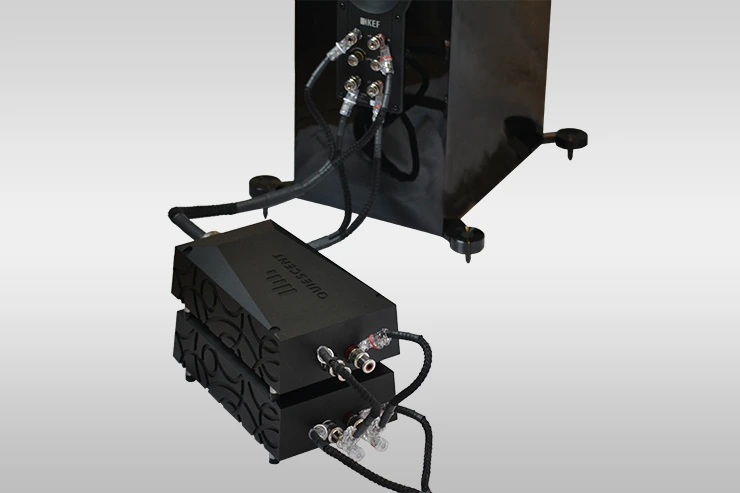
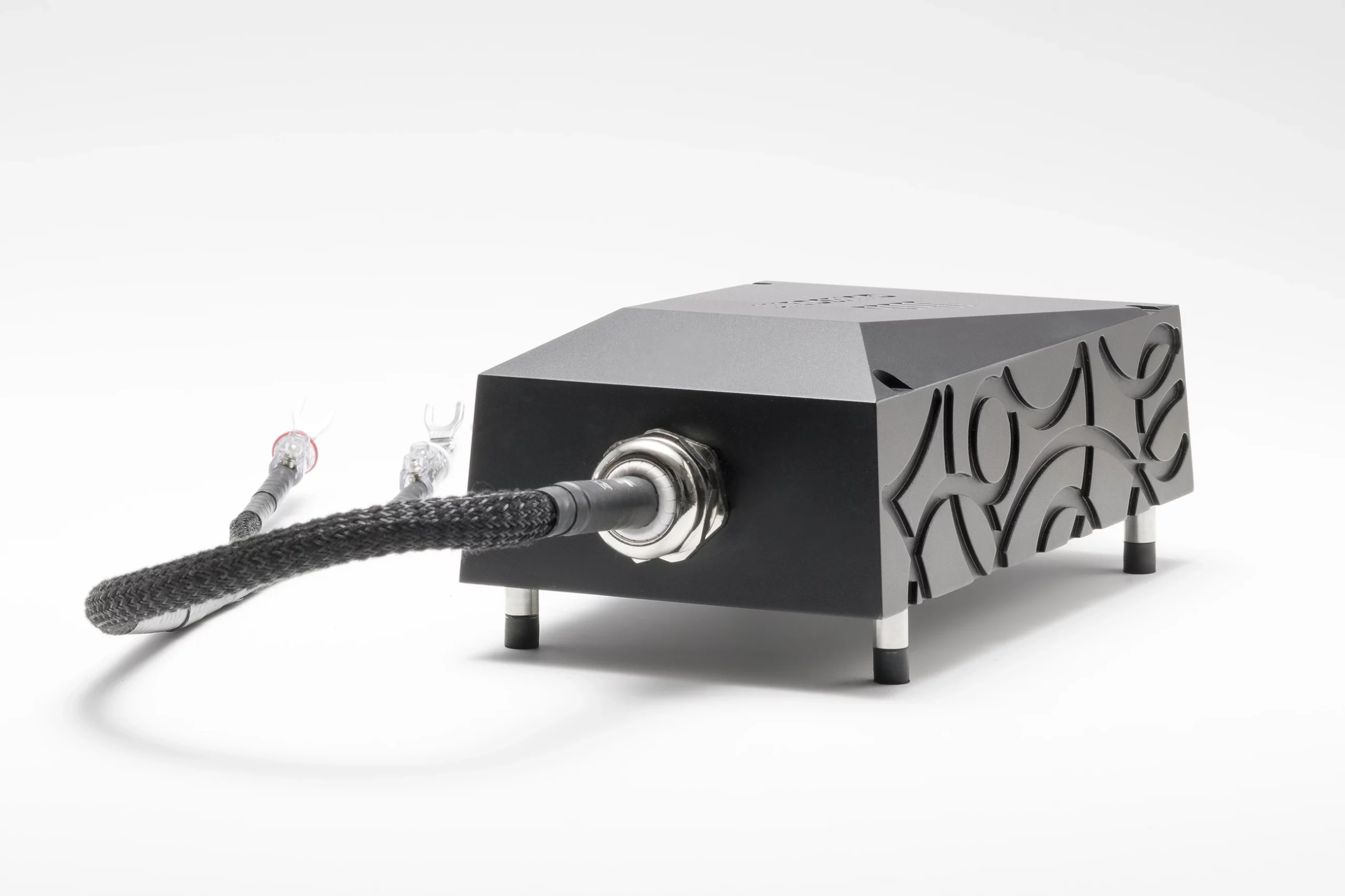
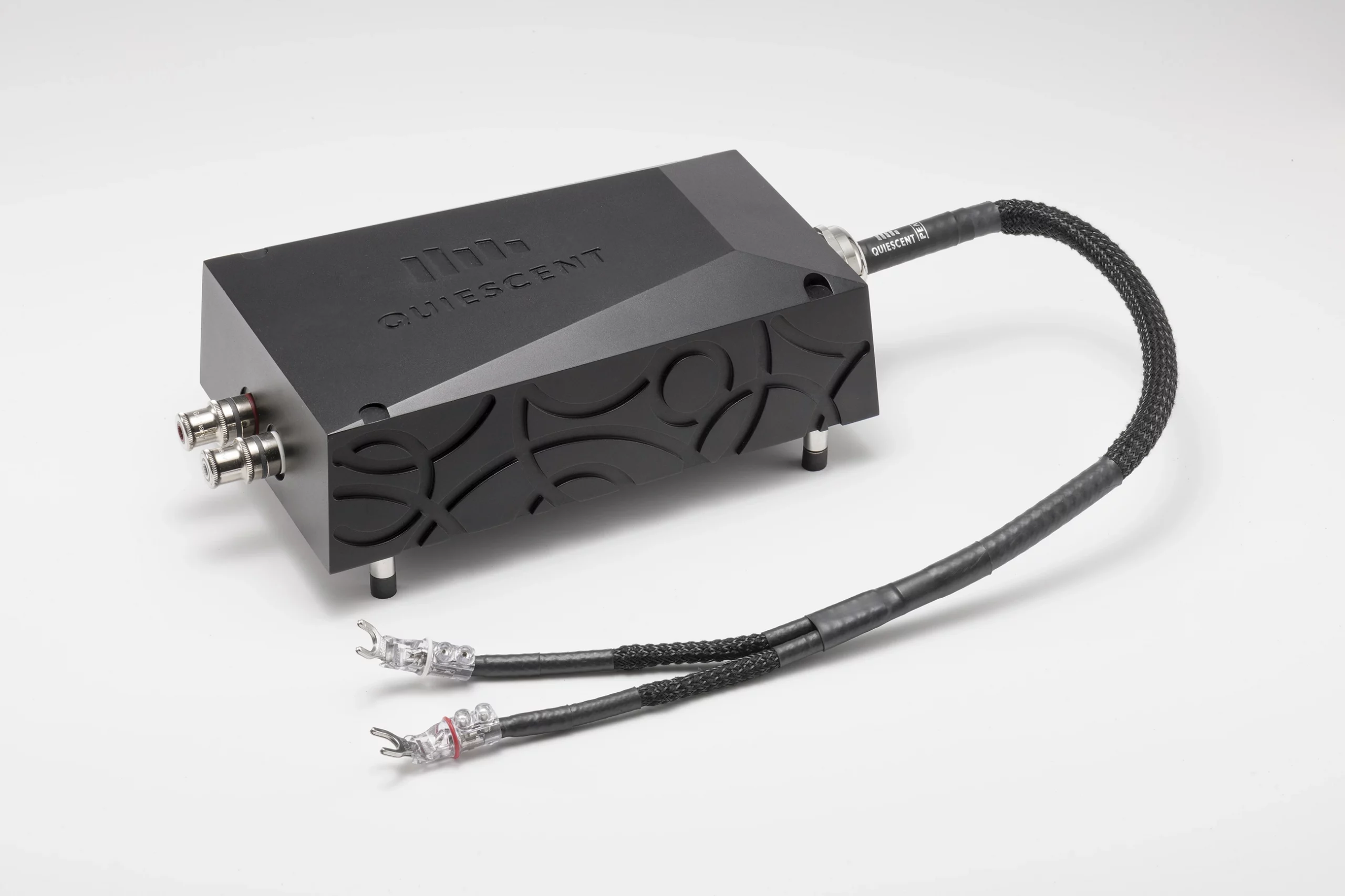
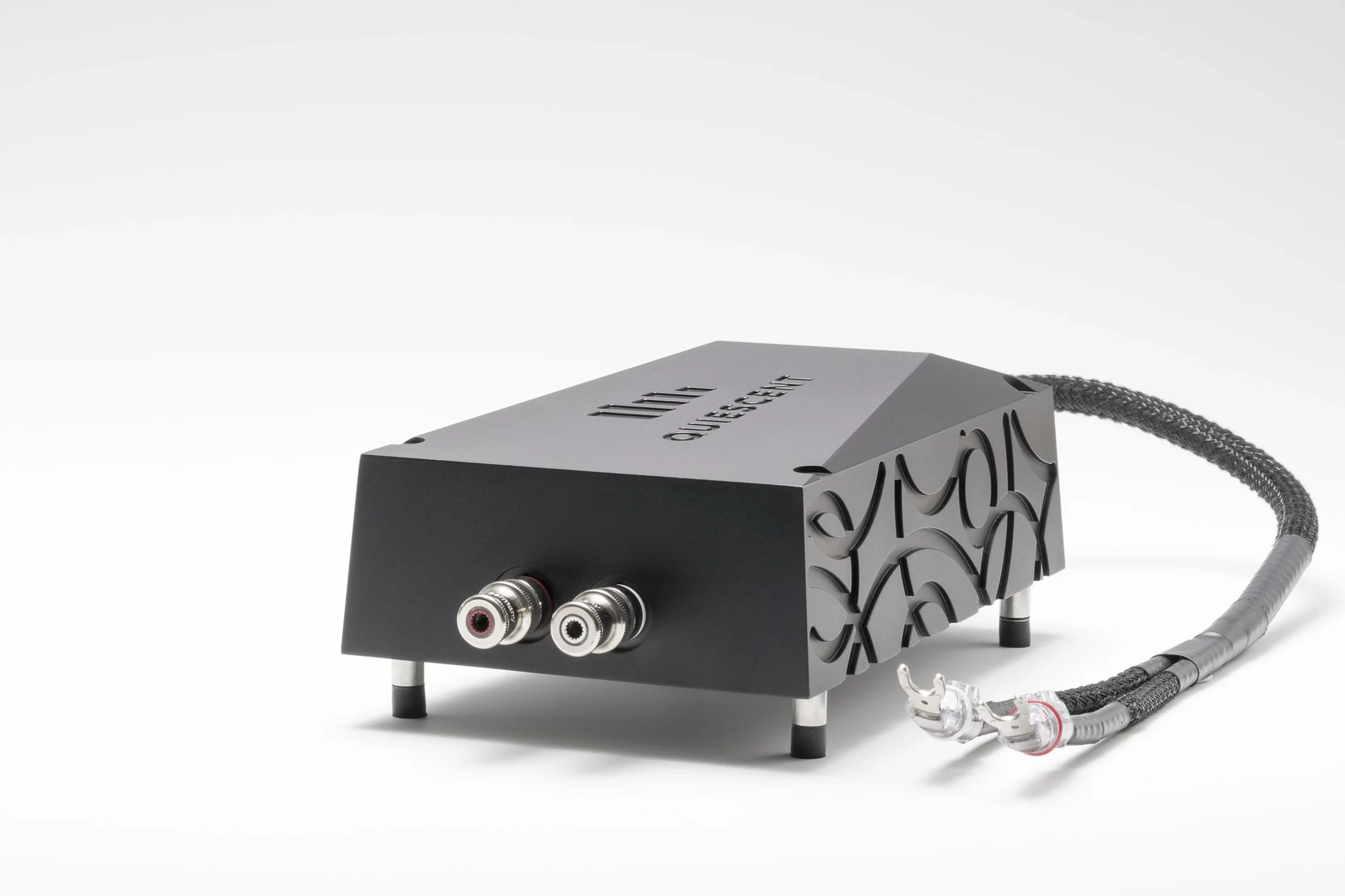
Low-resonance casework, solid silver connection
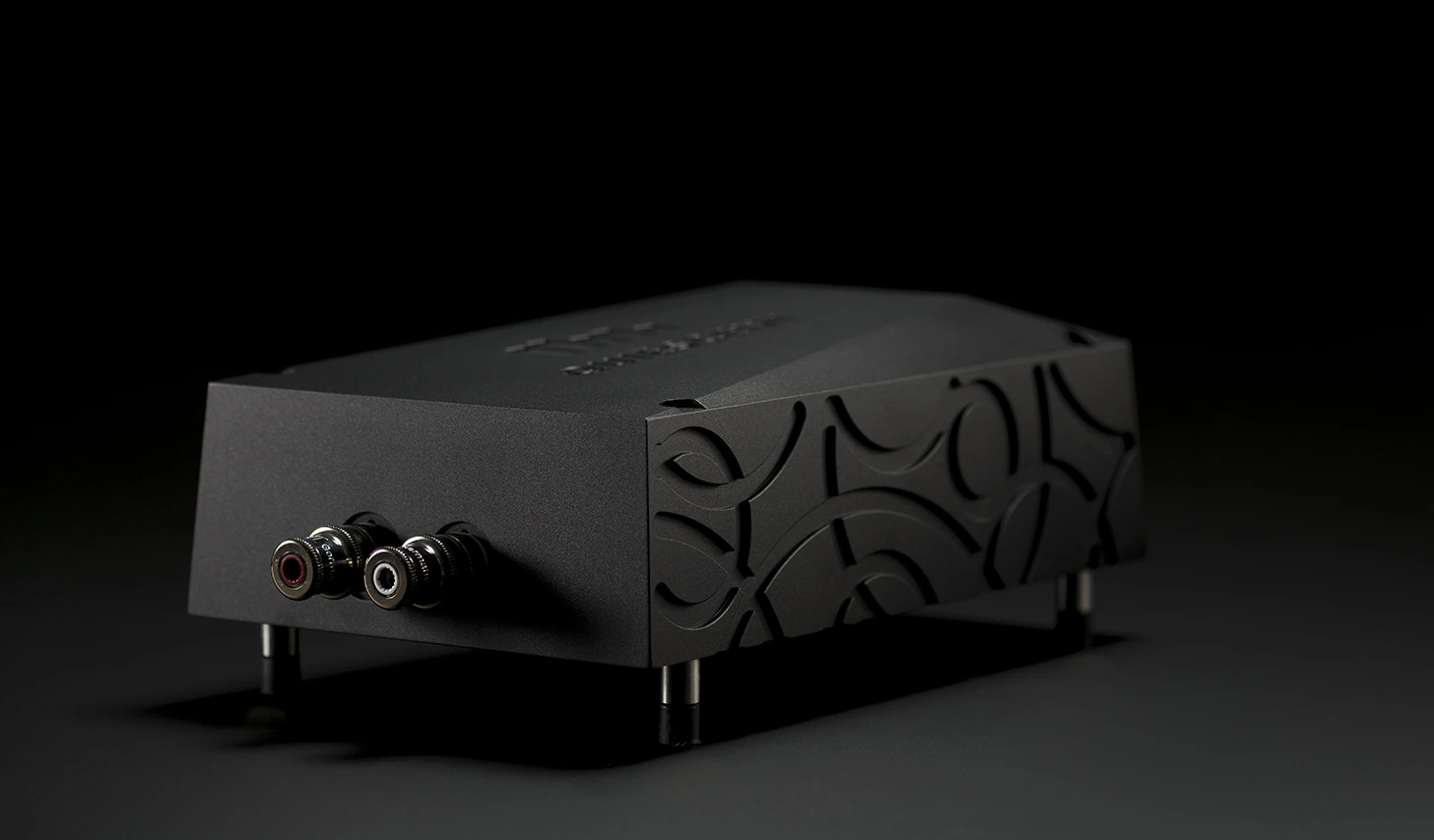
Peak Speaker Modules use ultra-low-resonance black anodised aluminium casework, a patented multi-phase wide-bandwidth electrical absorption matrix and proprietary mechanical absorption materials.
WBT nextgen silver pole terminals connect the module to the speaker cable, while short solid-silver lead-outs are supplied with either 8mm spades or 4mm banana plugs for connection to the loudspeaker.
For bi-wire and tri-wire systems, the modules can be stacked neatly at the loudspeaker terminals, allowing each driver section to be treated separately.
Why speaker cables matter to system quietness
The overlooked return path
Loudspeakers are designed to turn electrical energy into movement. That movement creates sound, but it also creates vibration within the driver assembly, cabinet, crossover and wiring. Even in a well-engineered loudspeaker, some energy remains inside the structure rather than being projected into the room.
The loudspeaker crossover is also active in this environment. Its capacitors, inductors, resistors, and internal wiring are not isolated from the loudspeaker’s mechanical and electrical behaviour. They store and release energy, respond to vibration, and present changing impedance conditions across frequency. At high frequencies, these components can become part of the same noise field that the speaker cable then carries back toward the amplifier.
The speaker cable is connected directly to this moving system. It is also connected directly to the amplifier. For that reason, it can act as a more efficient mechanical route back into the electronics than airborne vibration or energy travelling through the room structure.
Mechanical energy through conductors
Solid conductors are efficient paths for mechanical energy. A speaker cable therefore does more than carry current to the loudspeaker. It can also carry vibration from the loudspeaker back toward the amplifier, where it may excite circuit boards, output devices, connectors, capacitors and chassis structures.
Once inside the amplifier, this energy can contribute to microphonic behaviour. Small mechanical disturbances can become small electrical disturbances, appearing as noise or modulation around the signal the amplifier is trying to preserve.
Electrical energy on the speaker connection
The speaker cable is also a transmission path for high-frequency electrical energy. Although the desired musical signal lies within the audio band, modern audio systems contain high-frequency noise from switching supplies, digital sources, network devices, RF fields, and the amplifier itself.
At these frequencies, unwanted energy can travel along the speaker connection, reflect from impedance changes and form standing-wave behaviour. This does not need to be large to matter. It only needs to occur in the same system that is trying to preserve low-level timing, phase and spatial information.
Absorption rather than filtering
Peak Speaker Modules are not conventional speaker filters. They are absorption devices placed at the speaker connection to reduce unwanted mechanical and high-frequency electrical energy without placing a frequency-shaping network in series with the loudspeaker signal.
This follows the same principle as the Peak Mains Module. In the mains system, Quiescent gives high-frequency energy a controlled destination so it is less able to move between components. In the speaker system, Peak Speaker Modules apply that thinking to the path between loudspeaker and amplifier.
The patented multi-phase wide-bandwidth absorption matrix and proprietary EMI/RFI tubing are engineered to provide high return loss in the high-frequency domain. Rather than allowing unwanted energy to reflect along the cable, the module encourages absorption and dissipation.
Modular by design
Earlier approaches to this problem integrated absorption modules into the speaker cable itself. Peak Speaker Modules separate the absorption device from the cable, making the system easier to install, configure and adapt as systems change.
The modules can be used with Quiescent speaker cables or with an existing loudspeaker cable. If cable length changes later, the module remains in service. This makes the speaker connection system more flexible while preserving the Quiescent approach to absorption at the loudspeaker interface.
Bi-wire, tri-wire and amplifier-end use
In a single-wire system, a pair of Peak Speaker Modules is normally placed at the loudspeaker. In bi-wire or tri-wire systems, modules can be stacked and connected to each set of input terminals, allowing the low, mid and high-frequency sections to be addressed separately.
For the most complete Peak Speaker Connection System, an additional pair can be used near the amplifier. This extends the absorption approach at both ends of the speaker connection, reducing the opportunity for unwanted energy to flow freely between the loudspeaker and the electronics.
The system result
Peak Speaker Modules are designed to remove disturbance rather than add character. As mechanical vibration and high-frequency energy are reduced, the amplifier can behave with greater composure. Timing becomes easier to follow. Bass gains shape without excess weight. Images settle more naturally, and the system is less likely to harden as the music becomes complex.
The wider behaviour of high-frequency electrical and mechanical energy in connected audio systems is explored in The Physics of Quiet.
Specifications
Casework
Construction
Ultra-low resonance high-grade solid block aluminium casework (black anodised)
Dimensions
240 x 150 x 75 mm
Weight
4.5 kg per module
Absorption Technology
EMI/RFI absorption
Patented multi-phase, wide-bandwidth electrical absorption matrix and proprietary EMI tubing
Mechanical absorption
Proprietary casework design with 3D passive acoustic absorption materials
Connections
Lead-outs
WBT nextgen™ silver 8mm spades or WBT nextgen™ silver 4mm banana plugs
Module
WBT nextgen™ silver pole terminals
Cable
Length
0.5m or 1.0m
Conductors
Two 1.25mm 99.9% solid silver conductors with Teflon™ air-tube insulation for signal live and ground
Outer Covering
ABS acoustic absorbent braid