The Physics of Quiet

The Physics of Quiet begins with a simple idea: a real audio system is not only a sequence of boxes passing music forward. It is also a connected electrical and mechanical environment in which energy moves, reflects, couples and returns.

Most audio discussions begin with the familiar signal path: source, control stage, amplifier, loudspeaker and room. That chain is still useful, but it leaves something important out. A real audio system is not only a sequence of boxes passing music forward. It is also a connected electrical and mechanical environment in which energy moves, reflects, couples and returns.

Quiescent is interested in that environment. The design question is not simply whether a component has low distortion on a test bench, or whether a cable has acceptable resistance, capacitance and inductance at audio frequencies. Those things matter. But a high-resolution system also depends on how stable the operating conditions remain while music is playing and while the system is surrounded by modern high-frequency noise.
Noise is not evenly distributed

A field of energy around the signal

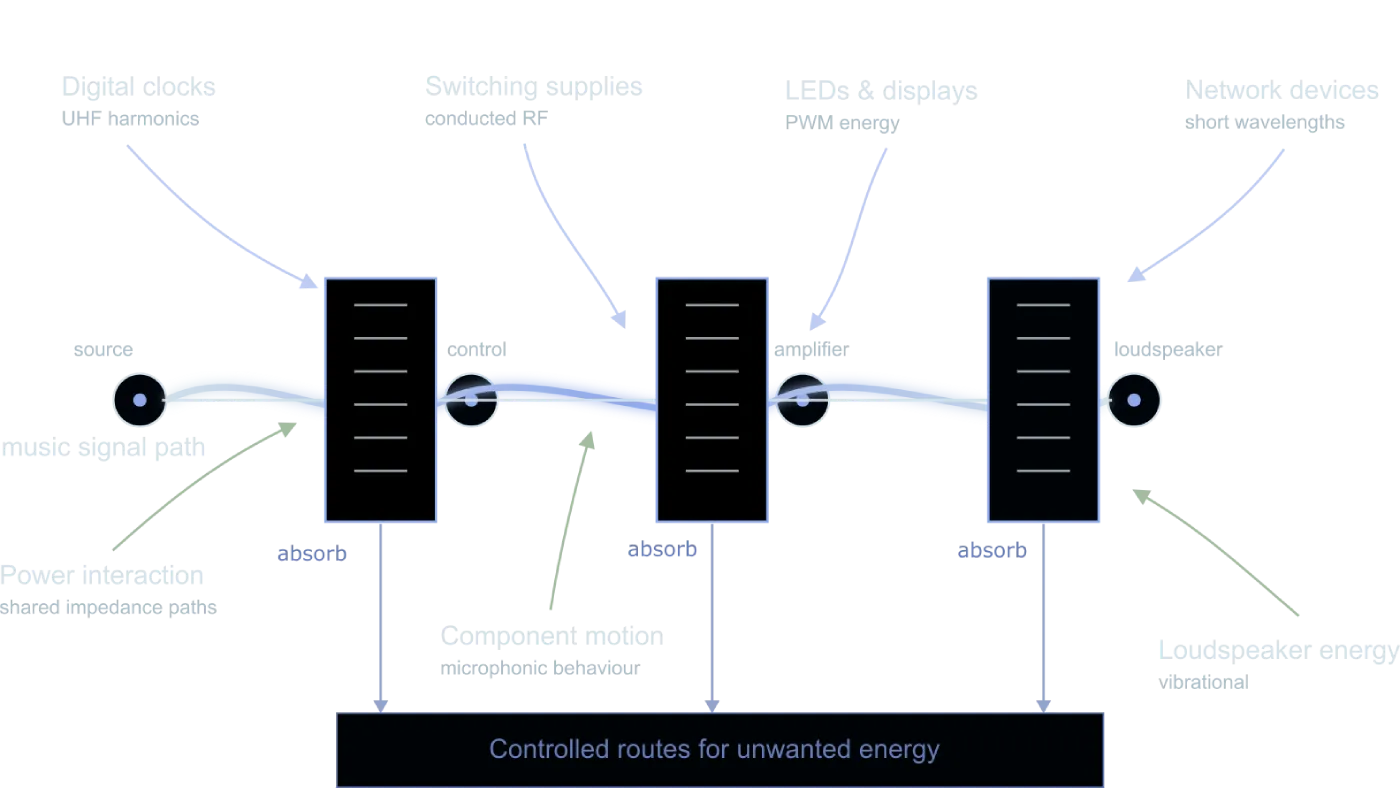
Digital clocks, switching supplies, LEDs, network devices and the audio components themselves all generate unwanted high-frequency energy. At short wavelengths this energy can reflect along cables, power paths and circuit structures, changing the conditions in which delicate music signals are handled. Quiescent products are designed to give that energy controlled routes away from the signal.

The Physics of Quiet diagram showing non-uniform high-frequency noise around an audio signal path

Why Modern Systems are Noisy

The traditional audio band runs from around 20 Hz to 20 kHz. At those frequencies, the wavelength of an electrical signal is extremely long compared with the dimensions of normal circuits and cables. This is why conventional audio design often treats interconnects, power paths, and circuit tracks as electrically short structures.

Modern audio systems do not live only in that world. Streamers, routers, DAC clocks, displays, LED lighting, switch-mode power supplies and domestic digital equipment all generate energy at much higher frequencies. Their harmonics can have wavelengths comparable to those of cables, circuit paths, and equipment spacing. At that point, the behaviour starts to resemble high-frequency engineering: energy can reflect, form standing waves and travel through routes that were not part of the intended audio path.

This matters because the noise is not always isolated inside the device that created it. It can be conducted through the mains, radiated through the environment, or coupled into grounding and signal paths. A system can therefore become a shared noise field rather than a set of independent components.

Every component creates signal-related electrical and mechanical disturbance

Components Are Physical Systems

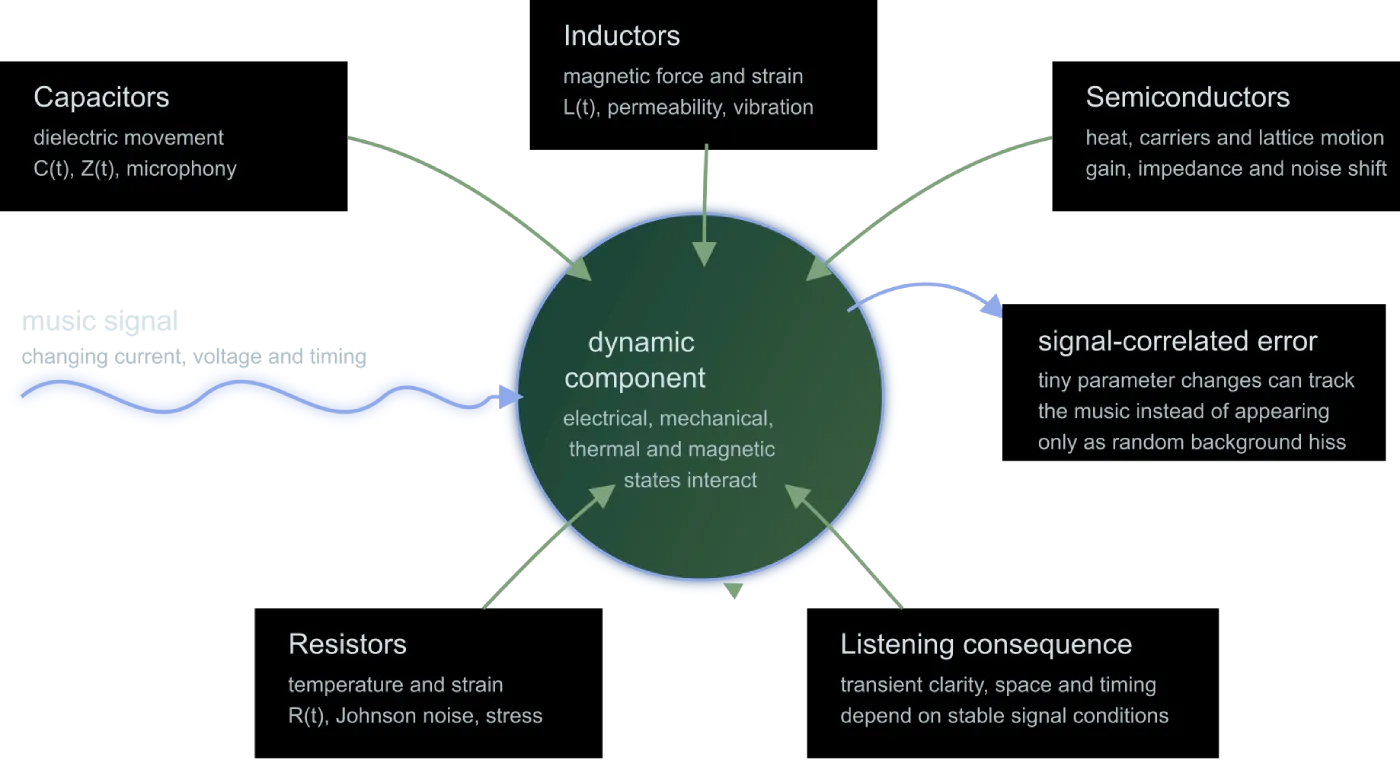
Audio components are often described as if capacitors, inductors, resistors and semiconductors were ideal mathematical parts. In practice, each is a physical structure made from materials that respond to electric fields, magnetic fields, heat and mechanical stress.

Diagram showing the dynamic nature of audio electronics components

Capacitors can be affected by dielectric movement. If tiny changes in spacing or dielectric behaviour occur while a signal is passing, capacitance and impedance are no longer perfectly fixed. Inductors and transformers are even more obviously electromechanical: changing current creates magnetic forces, and magnetic materials can physically change shape through magnetostriction. This is why transformers hum and coils can sing.

Resistors are also material systems. Their resistance is influenced by temperature, microscopic structure and strain. Semiconductors add another layer: carrier motion, local heating, and lattice vibrations all interact within the device. None of this means ordinary electronics are badly designed. It means real components are dynamic, and their behaviour can change slightly under the influence of signal, temperature, vibration, and high-frequency energy.

The important point for audio is that these changes are not always random. Some are linked to the music, the power demand or the noise field around the system. That makes them capable of producing signal-correlated error: small disturbances that rise and change with musical complexity.

Why Conventional Filtering Is Not Enough

Conventional filters remain essential. Capacitors, inductors, layout practice and screening all help control unwanted energy. But at very high frequencies, ideal component models become less reliable. Capacitors have parasitic inductance and resistance. Inductors have parasitic capacitance. Circuit boards, cable looms and grounding paths behave less like simple wires and more like distributed structures.

At short wavelengths, a component that should shunt noise to ground may no longer behave as a perfect short circuit. A choke that appears to block rising frequency in a simple model may pass or reflect energy above its self-resonant region. If the impedance transition is poor, energy is not removed cleanly; it is reflected back into the system.

This is why Quiescent thinks in terms of controlled absorption and return loss. In high-frequency engineering, a matched load absorbs incident energy instead of reflecting it. Audio systems are more complex because the audio-frequency signal and power delivery must remain materially unaffected. The design challenge is to provide unwanted high-frequency energy with a path away from the music without flattening dynamics or altering the musical character.

Why It Matters To Listening

The audible result of unwanted energy is not necessarily a simple hiss or buzz. Often it is more subtle: reduced ease, unstable image focus, flattened dynamics, grain around leading edges, or a sense that complex passages become strained.

One reason is that music is a time-domain event. The ear and brain are sensitive to timing, transient shape, spatial cues and the decay of harmonics. Conventional measurements such as frequency response, harmonic distortion and signal-to-noise ratio are valuable, but they are usually based on steady-state test conditions. Music is not steady state. It is constantly changing in amplitude, harmonic structure and timing.

If the system’s electrical and mechanical environment changes while music is playing, the system can become less accurate at tracking the original waveform over time. Short-term errors are especially important because they are influenced by noise, microphony, grounding behaviour, power quality and mechanical instability. Reducing those errors using the Physics of Quiet helps the system preserve timing relationships, low-level detail and spatial coherence.

The Physics of Quiet in Practice

This is why Quiescent treats power, grounding, cables, speakers, and amplification as a single connected system. Our products are designed around the system, not only around individual boxes. Power management, component grounding, interconnects, speaker connection products and T-Series amplifiers all address different parts of the same problem: unwanted energy moving through a connected audio environment.

The aim is not to add a signature or impose a tonal balance. It is to make the conditions around the signal quieter and more stable, so the equipment already in the system can perform closer to its own potential. When the noise field is reduced, the listener does not hear the treatment itself. They hear more of the musical event: clearer starts and stops, more natural decay, stronger spatial relationships and a calmer sense of presence.

This is the Physics of Quiet in practice. Not silence as absence, but quiet as control: fewer uncontrolled reflections, fewer mechanically correlated errors, and fewer routes for high-frequency energy to disturb the signal.

Discuss your system

Get in touch directly...